


We tend to treat sleep like a light switch: lie down, close your eyes, and expect the room to go dark in our heads too. When it doesn't happen on cue, we try harder — and trying harder is exactly the wrong move. The body doesn't fall asleep on command. It eases into sleep, gradually, over the half hour or so before you actually drift off.[1] dasdasdqedasd
That stretch of time has a name worth knowing: the wind-down. It's the bridge between the alert, daytime version of you and the calm, ready-for-rest version. Some nights you cross it in minutes. Other nights you pace back and forth on it, wide awake, wondering what's wrong. The encouraging part is that the wind-down is learnable — a set of signals you can give your body so it recognizes the path and travels it faster.
Why falling asleep feels harder than it should
For something so natural, falling asleep can feel maddeningly out of reach. Part of the reason is modern life: we ask our bodies to switch from a bright, stimulating, always-on day to deep rest with almost no transition.
The other part is effort. Sleep is one of the few things in life that gets further away the harder you chase it. Lying in bed willing yourself to sleep raises a low hum of pressure, and that pressure keeps you alert.[2]
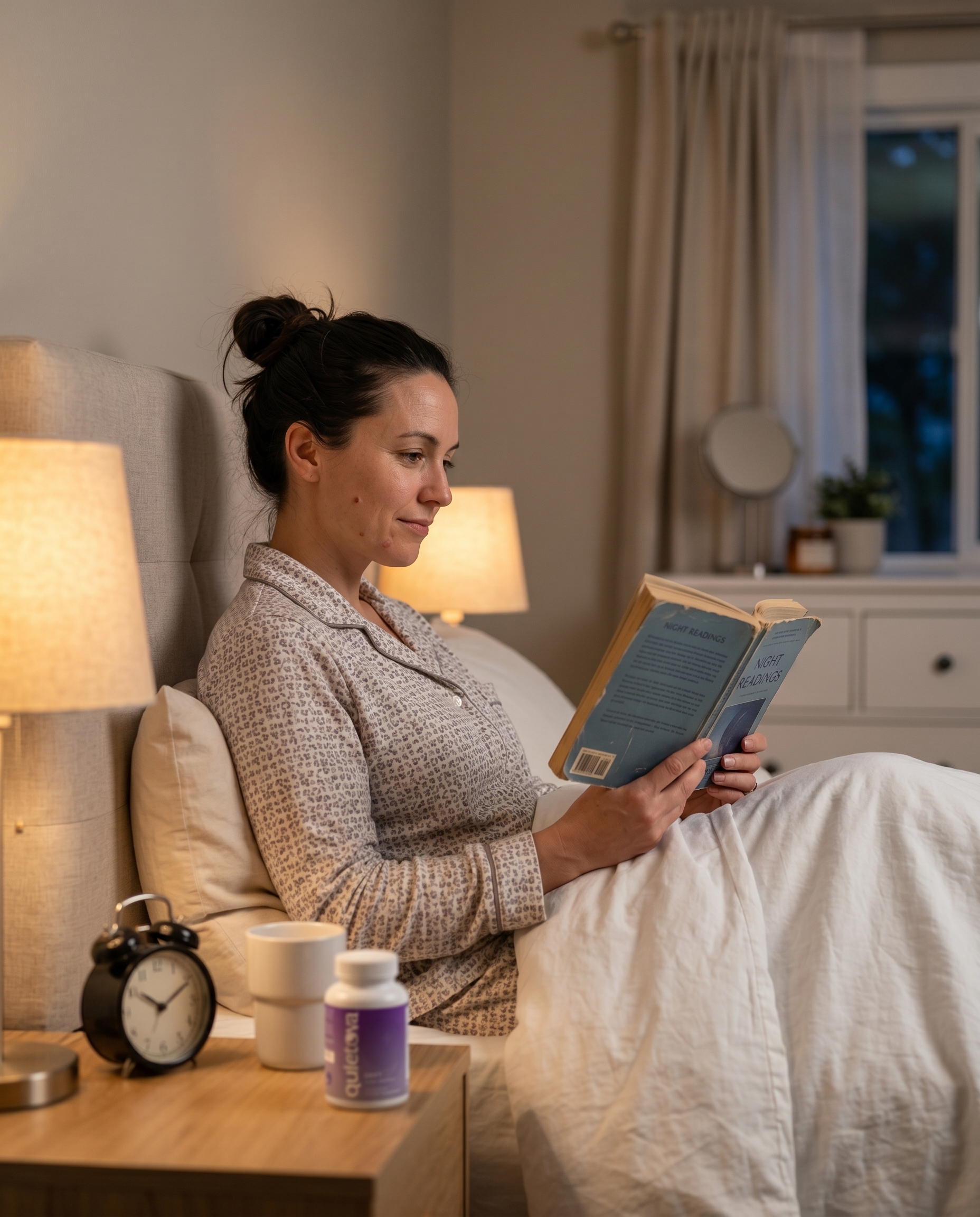
Your body has a built-in dimmer switch
As evening sets in, your internal clock begins nudging you toward rest. Your core body temperature starts to drop, attention softens, and the brisk momentum of the day quietly fades.
Sleep follows a routine, not a command. The more consistent your wind-down, the faster your body learns to let go.
— On building a sleep-friendly evening
The practical takeaway is simple but powerful: you can't force the dimmer down, but you can stop holding it up.
Four habits that help you drift off
You don't need to overhaul your life to sleep better. A handful of small, repeatable cues — done most nights — do more than any single dramatic change.
1. Dim the lights an hour before bed
Light is the loudest signal your clock listens to. Bright, blue-leaning light in the evening tells your brain it's still daytime; warm, low light tells it the opposite.
2. Keep your timing consistent
Your circadian rhythm thrives on regularity. Going to bed and waking up at roughly the same time keeps the dimmer on a predictable schedule.
Pick a realistic bedtime window and protect it most nights.
Get bright light in the morning to anchor the other end of the cycle.
Put screens away, or shift them to a warm, low-brightness mode.
Cool the room a degree or two — a slightly cooler space is easier to fall asleep in.
Quieting a busy mind
For a lot of people, the body is ready long before the mind is. The gentler approach is to give your mind somewhere to land — journaling, slow breathing, or a calm playlist.
And if sleep simply isn't coming after twenty minutes or so, the counterintuitive move is to get up. Lying in bed frustrated only deepens the link between the bed and being awake.
When to consider a little support
For some people, a consistent routine is enough on its own. For others, a thoughtfully chosen supplement can be part of the wind-down — emphasis on part of.
The best sleep support disappears into your routine — a quiet nudge in the right direction, not a hammer.
— The Quietova Team
This is general, educational information, not medical advice. If you're pregnant or nursing, take medication, or have a health condition, talk with your physician before adding any supplement.
Wrapping up
Falling asleep faster usually isn't about one big change — it's about a handful of small, repeatable signals that tell your body it's safe to let go.
Most of all, take the pressure off. The nights you sleep best are rarely the nights you tried hardest — they're the nights you simply made room for rest and let it come.

Comments
Sign in to join the conversation.
No comments yet. Be the first.