
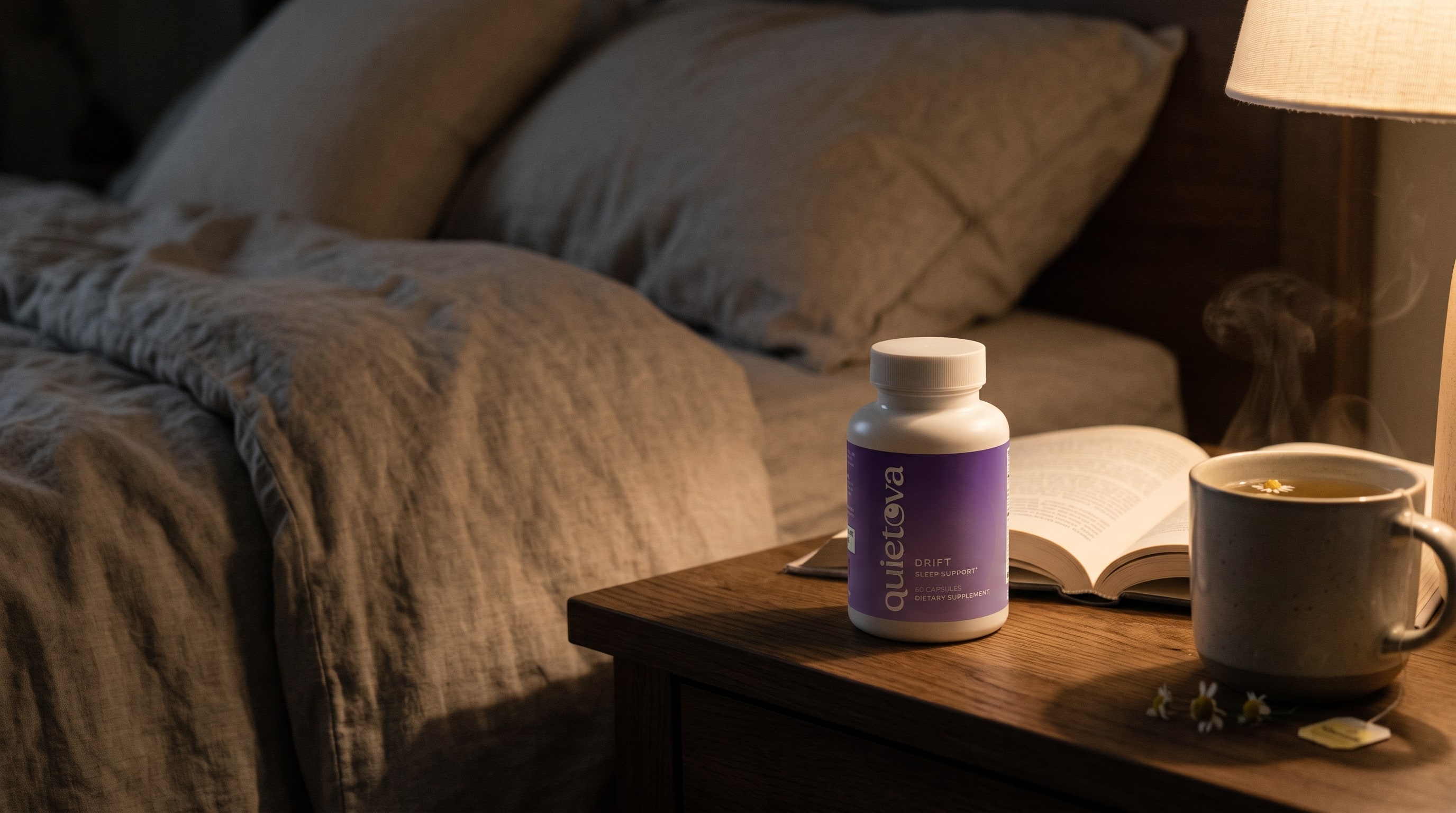

Natural sleep aids: the big picture
A natural sleep aid is anything that supports your sleep without a prescription. Most fall into four groups.
Four kinds of natural sleep support
Calming plants
Valerian, hops, chamomile, passion flower, lemon balm, lavender and ashwagandha.
Melatonin
The signal your brain makes in the dark to mark nighttime.
Magnesium, 5-HTP, L-theanine
Minerals and building blocks your body already uses.
Your wind-down
Light, temperature, screens and a quieter mind. Free, and the base for the rest.
Why use herbs for sleep?
Herbs feel gentle, carry long traditions, and slip easily into your bedtime ritual, like a cup of tea. Many are traditionally used to help your body unwind. Some are thought to work on GABA, your brain's main calming messenger.
Do any herbs make you sleep instantly?
If you've searched for herbs that make you sleep instantly, here's our straight answer: sleep tends to come gently, and herbs work with that pace. They're traditionally used to help you unwind so sleep can follow.
Valerian has been used for sleep since ancient Greece, and chamomile has a long history as a bedtime tea. As a supplement, melatonin may help shorten the time it takes to fall asleep [1].
So give them a steady place in your evening routine.
What's really keeping you up at night?
Before reaching for any sleep aid, it helps to name what's keeping you awake.
| What keeps you up | What's going on | Try first |
|---|---|---|
| A racing mind | Worry releases stress hormones that keep your brain alert | Write your worries down |
| Light at night | Light can block your melatonin | Dim your lamps, screens away |
| A warm, noisy room | A quiet, cool, dark room is a core sleep habit | Cool, darken and quiet your room |
| A stressful day | Tension from your day follows you to bed | Calm breaks during your day |
What causes anxiety when trying to fall asleep?
Anxiety sets off your stress response. Its hormones raise your heart rate and keep your brain alert, a state called hyperarousal [4].
In the quiet dark, your worries can replay, and it becomes a loop: worry hurts your sleep, and poor sleep feeds more worry [4]. You might even start to dread bedtime, which is called sleep anxiety [4].
Daytime calm vs. nighttime sleep support
That's why your good night often starts in the morning. Stress that builds all day doesn't clock out at bedtime, so we think about your calm in two halves: easing your busy days, and winding down at night.
Simple ways to fall asleep more easily: your evening plan
The best natural sleep support for you is often free. Here's a simple plan that pairs your home habits with a supplement, if you choose to use one.
A calm evening, step by step
- Daytime
Ease the pressure
Take short calm breaks so your stress doesn't pile up by night.
- Early evening
Dim the lights
Switch to low lamps, since light at night can block your melatonin.
- 1 hour before bed
Screens down, worries out
Park your phone and jot tomorrow's worries on paper to ease rumination.
- 30 minutes before bed
Supplement, if you use one
Follow the label. For Drift, that's two capsules 20 to 30 minutes before bed.
- Lights out
Cool, dark, quiet
Settle into your cool, dark, quiet room and try a relaxation exercise.
Relaxation techniques that can help you sleep
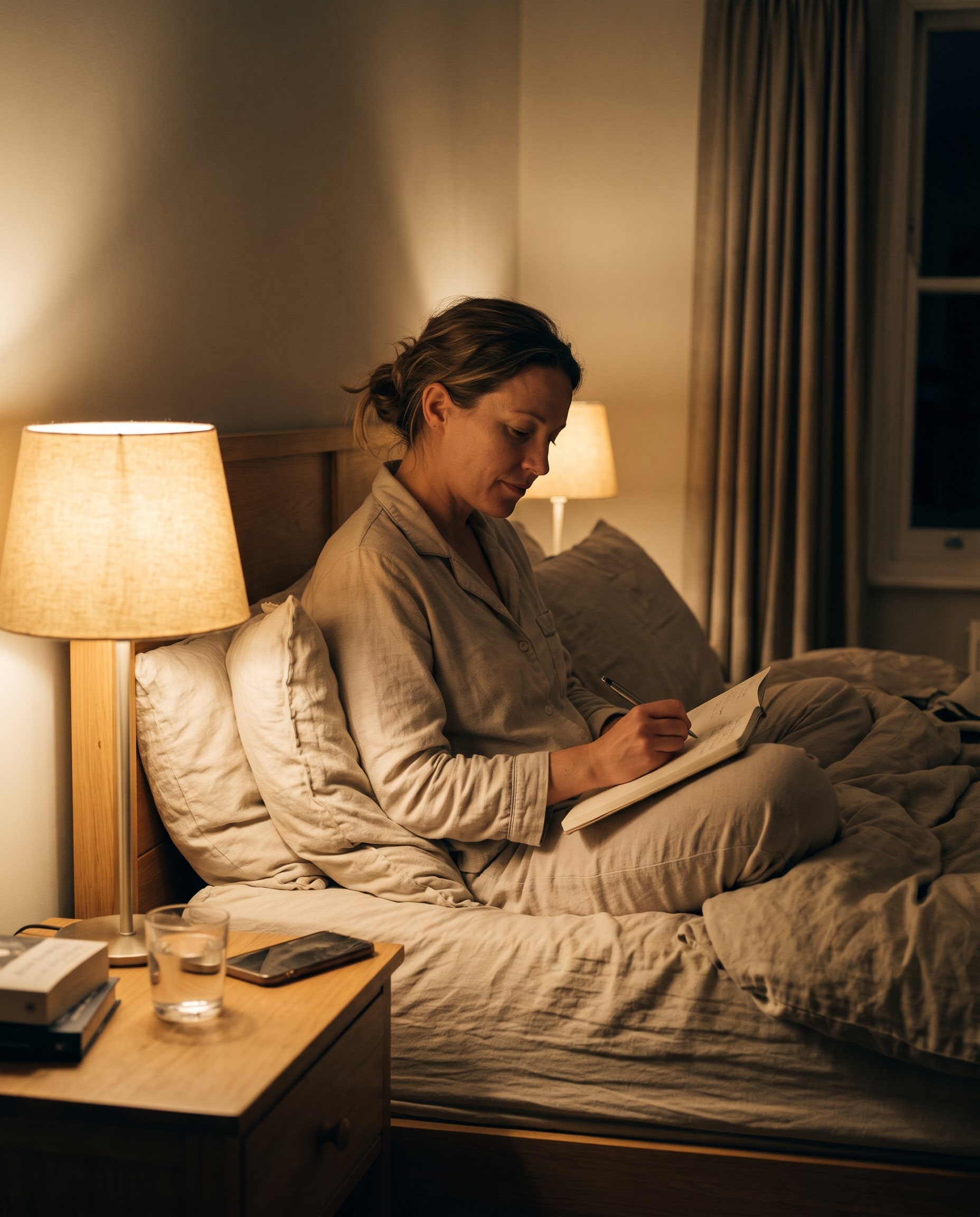
Progressive muscle relaxation: tense one muscle group, then release it, working up your body [3].
Belly breathing: slow, deep breaths into your belly, also called diaphragmatic breathing [3].
Guided imagery: picture a calm scene in rich detail [3].
These are some of the gentlest ways to ease your busy mind at bedtime. They bring on the relaxation response, the opposite of the stress response [3]. They're also part of CBT-I, a talk therapy built for sleep [1].
If one leaves you feeling tense, which can happen, simply try another [1]. For the why behind each step, see how winding down helps you drift off.
Natural herbs for sleep, one by one
Here's why you might reach for the herbs you ask us about most, including the ones called the strongest herbs for sleep, and what to know about each.
| Herb | Why you might use it | Good to know |
|---|---|---|
| Valerian root | One of the most-studied traditional sleep herbs, used since ancient Greece and thought to act on GABA, the brain's calming messenger | Sedating: don't mix with alcohol or sedatives |
| Hops | A long folk history in sleep pillows, and often paired with valerian | Sedating botanical: same alcohol and sedative caution |
| Passion flower | A climbing vine used traditionally for restlessness; research suggests it may support total sleep time | Calming botanical: avoid with alcohol or sedatives |
| Ashwagandha | An Ayurvedic herb ('somnifera' means sleep-inducing); a review of trials found a significant effect on overall sleep | Ask your doctor first if you take medication |
| Chamomile | A long history as a bedtime tea; its compound apigenin binds to the same brain receptors as some calming medicines | Skip it if you're allergic to ragweed |
| Lavender | A classic wind-down scent; research suggests aromatherapy may support sleep quality | Easy to use as a bedtime scent |
| Lemon balm | A lemon-scented mint traditionally used to calm nerves, thought to support GABA | Can add to drowsiness; ask your doctor first if you take medication |
| St. John's Wort | A yellow-flowered herb traditionally used for mood, found in some calming blends | Interacts with many medications: talk to your doctor first |
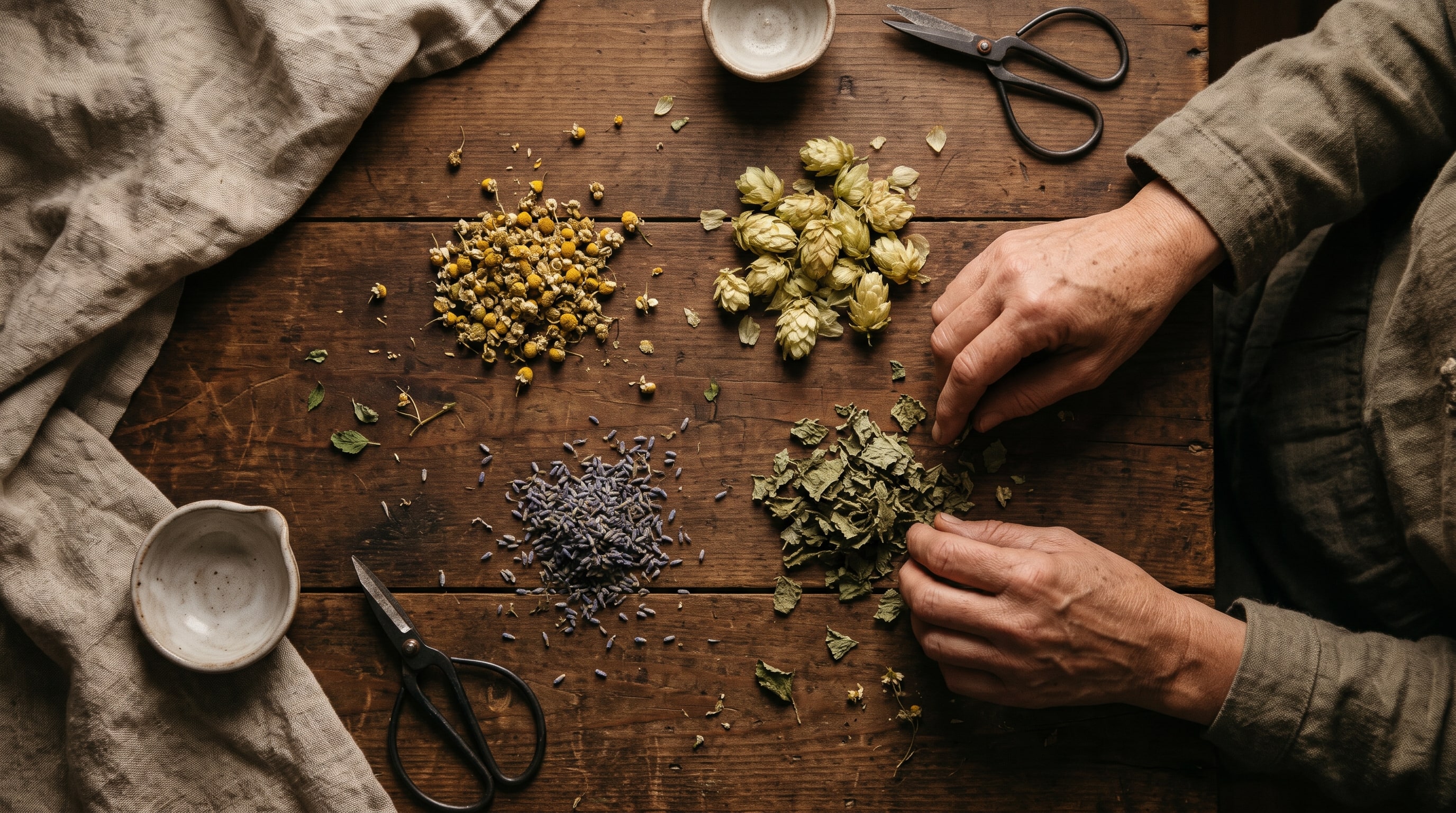
Our nightly formula, Drift, contains chamomile, hops, passion flower, lemon balm, ashwagandha, St. John's Wort and Chinese skullcap root in its Sleep Formula blend. Because St. John's Wort interacts with many medications, check with your doctor before use if you take any.
Beyond herbs: melatonin, magnesium, 5-HTP and L-theanine
Melatonin and your body clock
Melatonin is a hormone your brain makes in response to darkness, and it helps time your body clock [2]. Light at night can block it [2], so dim lights and good timing matter.
As a supplement, research suggests it may help you fall asleep a little faster [1]. It may also help with jet lag [2]. Short-term studies reported only mild side effects, like headache or sleepiness [2].
Keep to label use, since it can cause next-day grogginess. If you take medicine, especially blood thinners, or have epilepsy, ask your provider first [2]. Our guide covers when to take melatonin.
Magnesium forms compared: why glycinate is popular at night
Magnesium is a mineral your muscles and nerves use every day, and it helps regulate your nervous system and muscle relaxation. That's why it can earn a place in your evening.
The NIH lists citrate, aspartate, lactate and chloride among the forms most easily absorbed [5]. Glycinate, magnesium bound to the amino acid glycine, is known as a gentle, well-absorbed form, which makes it a popular evening pick.
Keep your supplement magnesium at 350 mg a day or less, since more can cause diarrhea, nausea or cramps, and it can interact with some medicines [5].
5-HTP and L-theanine: how they differ from herbs
Unlike whole plants, these are single compounds. 5-HTP is a building block your body turns into serotonin, which it later uses to make melatonin. L-theanine is an amino acid, a small building block of protein.
5-HTP supports normal serotonin levels, so it sits right in the sleep-signal chain, and research notes it has calming, sedative effects [1]. L-theanine comes from tea leaves and is linked to relaxed alertness, calm without drowsiness. It's why green tea feels different from coffee.
Don't take 5-HTP with SSRIs, MAOIs or other serotonergic drugs without your doctor. A related nutrient, L-tryptophan, can cause serious serotonin toxicity with those medicines [1]. Drift contains both, so the same care applies.
Melatonin or melatonin-free: choosing what fits
Like a melatonin signal at bedtime? Drift pairs melatonin, which encourages the natural sleep cycle, with magnesium citrate and vitamin B6, which support normal muscle and nervous-system function, plus its calming botanical blend.
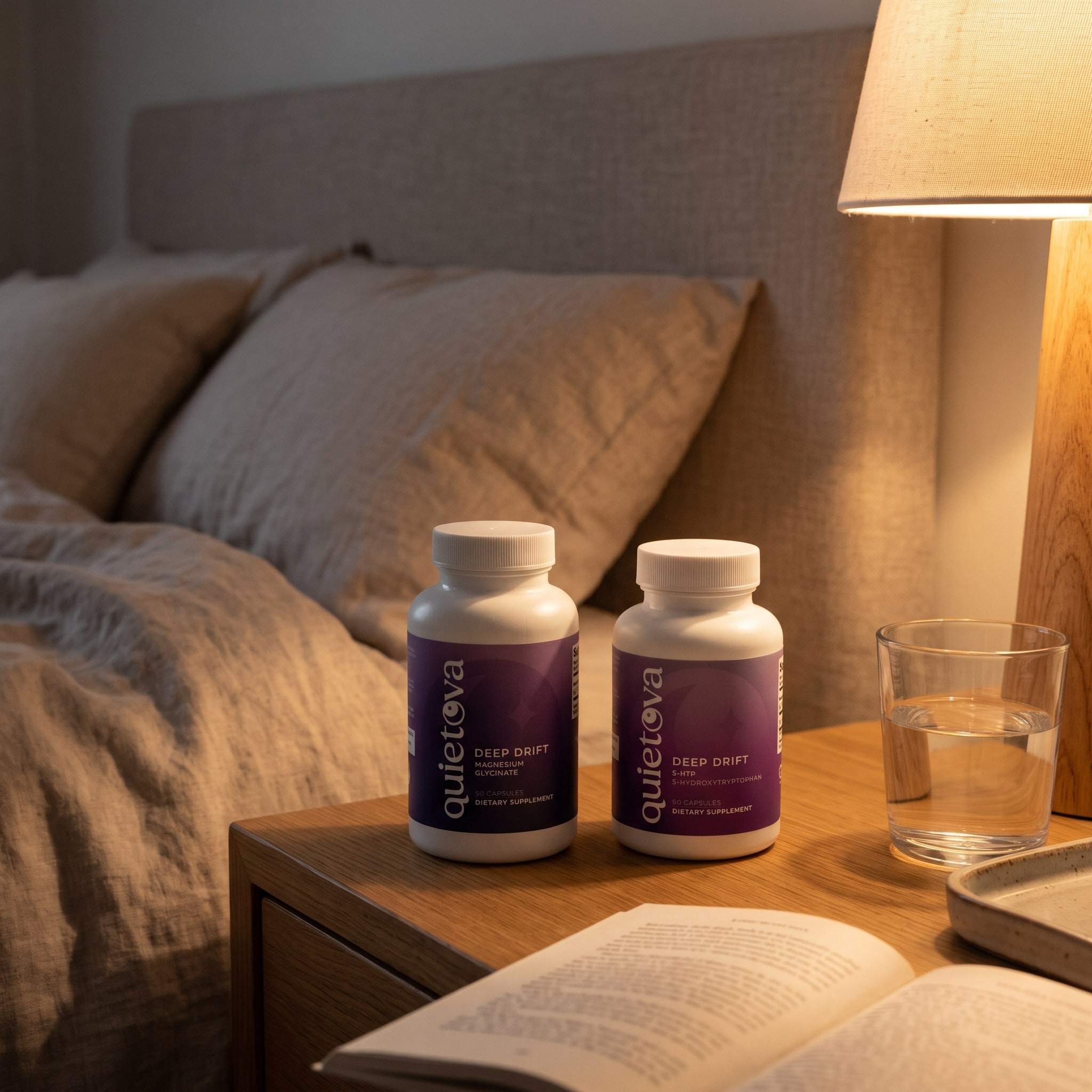
Prefer to skip melatonin? Deep Drift is our melatonin-free stack: 275 mg elemental magnesium from 2,500 mg magnesium glycinate per 3 capsules, plus 5-HTP (2 capsules daily). That's under the 350 mg daily limit for supplement magnesium [5], and magnesium glycinate supports muscle relaxation and healthy sleep patterns.
For the daytime half, Exhale gummies support calm through busy days with 200 mg reishi mushroom extract and 25 mg each of L-theanine, lemon balm, passion flower and valerian root. Because valerian is sedating, don't pair Exhale with alcohol or sedatives.
Safety basics: labels, stacking and your provider
Pick one night product. Drift and Deep Drift both contain magnesium and 5-HTP, so we don't suggest stacking them.
Add up your magnesium from every supplement and stay at 350 mg a day or under [5].
Skip mixing sedating products with alcohol or sleep medicines.
Keep reading
Frequently asked questions
What are some relaxation techniques that can help me sleep?
Try progressive muscle relaxation, slow belly breathing or guided imagery. They bring on the relaxation response, the opposite of stress, and fit well into your steady wind-down. If one leaves you tense, try another.
What causes anxiety when trying to fall asleep?
Stress hormones keep your brain alert, and quiet time in bed gives your worries room to replay. Writing your worries down before bed can help.
What are the strongest herbs for sleep?
Ashwagandha, whose botanical name somnifera means sleep-inducing, supported overall sleep in a review of trials. Valerian is the best known, with a sleep tradition going back to ancient Greece.
What are natural ways to support deep sleep?
Start with the free ones: a cool, dark, quiet room, dim evening light and your own steady routine. Supplements like magnesium, melatonin and calming herbs can add support on top.
References
- Sleep Disorders and Complementary Health Approaches: Usefulness and Safety. NCCIH (NIH).↩
- Melatonin: What You Need To Know. NCCIH (NIH).↩
- Relaxation Techniques: What You Need To Know. NCCIH (NIH).↩
- Sleep and Anxiety Disorders: How Anxiety Affects Sleep. Sleep Foundation.↩
- Magnesium - Fact Sheet for Consumers. NIH Office of Dietary Supplements.↩
- Effect of Ashwagandha (Withania somnifera) extract on sleep: A systematic review and meta-analysis. PLoS One via PubMed (NIH).↩
These statements have not been evaluated by the Food and Drug Administration. This product is not intended to diagnose, treat, cure, or prevent any disease.
Comments
Sign in to join the conversation.
No comments yet. Be the first.