


Does sugar keep you awake? What the research links it to
Maybe you've had a late bowl of ice cream and then stared at the ceiling for an hour. If so, you've probably wondered whether the sugar did it.
The real answer is that sugar and sleep are linked in the research, but the link is more tangled than a simple yes.
So sugar may play a part in a restless night. But it's only one piece, and the rest of this guide helps you figure out what's really going on in your own evenings.
Does sugar make you sleepy or awake?
Both feelings are real, and that's what makes sugar so confusing. You might feel a lift right after a sweet snack, feel heavy a little later, and then lie awake at bedtime.
Can sugar make you energetic?
Sugar is quick fuel. Foods with a high glycemic index push your blood sugar up fast, and your body releases more insulin, the hormone that moves that sugar into your cells [1].
Why does sugar make me sleepy right away?
Bodies react differently, and we didn't find solid research that explains the heavy feeling right after sweets. That includes the idea that sweets cause a blood sugar low (hypoglycemia) that makes you drowsy, so we won't claim it.
Why sugar may be keeping you up at night: the leading idea
Here's the part researchers are still sorting out. A review of diet and sleep research says the reasons behind the sugar and insomnia link have been suggested, but not completely solved [1].
Here's the leading idea, step by step.
High-glycemic foods raise your blood sugar quickly. [1]
Your body releases more insulin in response to that quick rise. [1]
Researchers suggest this swing may trigger hormones like adrenaline and cortisol. This is an idea, not a proven cause. [1]
Adrenaline and cortisol are hormones that help your body stay alert and ready to act. If they rise at night, lighter sleep would make sense [1].
Can blood sugar swings wake you in the middle of the night?
They might, but we can't say for sure. The stress-hormone idea is a hypothesis, a best guess that still needs testing, so a blood sugar drop isn't a proven cause of night waking [1].
Is 'sugar keeps you awake' a myth? What the studies show
So, does sugar actually keep you awake? It's not a myth, and it's not a verdict either.
The studies on the role of carbohydrates on sleep have mixed results.
Here's what three well-known studies found, and who was in each one.


Three studies, three angles
Each looked at sugar and sleep in a different way.
More sugar, lighter sleep
Researchers looked at what volunteers ate during the day, not just at bedtime. Low fiber and high saturated fat and sugar were linked to lighter, less restful sleep with more awakenings.
- Published
- Journal of Clinical Sleep Medicine, 2016
- Who
- Normal-weight volunteers
- Shows
- A link, not a cause
High-glycemic diets and insomnia
This study followed postmenopausal women over time. Diets higher on the glycemic index were linked to more new cases of insomnia.
- Published
- American Journal of Clinical Nutrition, 2020
- Who
- Postmenopausal women
- Shows
- A link, not a cause
A high-glycemic dinner, faster sleep
Volunteers ate a high-glycemic or a low-glycemic meal four hours before bed. After the high-glycemic meal, they fell asleep faster.
- Published
- 2007
- Who
- 12 healthy volunteers aged 18 to 35
- Timing
- Meal 4 hours before bed
So what does this mean for you? The science isn't settled, and the studies looked at different things: one at a single meal's timing, others at your whole day's eating.
The women's study has limits worth knowing. It was observational, meaning it watched what happened over time rather than testing a change, and it only included postmenopausal women [2].
Its authors say high-glycemic diets could be a risk factor for insomnia in that group, which is careful wording for a reason [2]. And since these studies differ so much in who they included and how they were run, they're hard to compare head to head [1].
Natural sugar vs. added sugar: does fruit count?
Not all sweetness seems to act the same. Here's what the large women's study found [1].

Whole fruit or added sugar?
What one large study linked to each.
Linked to less insomnia
Whole fruit comes with its own fiber. Eating more whole fruit and more fiber was linked to less insomnia, both at the start of the study and over time.
- Linked to
- Less insomnia
- Form
- Whole fruit, not juice
Linked to more insomnia
Added sugar is sugar put into foods and drinks, like sweets, desserts and sweetened drinks. More of it was linked to more new insomnia.
- Linked to
- More new insomnia
- Also linked
- Starch and refined grains
Sneaky 'healthy' sweets worth a second look
Some evening snacks feel light but can still lean on added sugar or refined grains. Flavored yogurt, granola, fruit juice and 'healthy' dessert bars are good ones to check.
The label tells you more than the front of the box. Look at the added sugars line, and scan the ingredients for chocolate or tea, since both bring caffeine [5].
What foods keep you awake at night?
When something sweet keeps you up, sugar isn't always the main player. Hidden caffeine may be the real reason, and it turns up in places you might not expect [5].
Caffeine in sweets and sweet drinks
| Sweet | Caffeine | Worth knowing |
|---|---|---|
| Sweet, semisweet or dark chocolate | 10 mg per ounce | A few squares still count |
| Unsweetened baking chocolate | 58 mg per ounce | Much more than sweet chocolate |
| Most colas | 45 mg per 12 ounces | Unless labeled caffeine-free |
| Black or green tea, including sweet iced tea | 60 to 100 mg per 16 ounces | Iced tea is still tea |
| Some candies, energy drinks, snacks and gum | 40 to 100 mg per serving | Check the ingredients list |
Caffeine can make it harder to sleep [5].
So a cola with dessert, or a few squares of chocolate late in the evening, could be doing more than the sugar alone.
Why can't I sleep after eating red meat?
We didn't find research on red meat by itself. But the lab study above also tied more saturated fat during the day to less deep sleep [1].
So if your dinner was rich in saturated fat, that's one possible piece of the puzzle.

Why evening sugar cravings happen, and the sleep loop
If you crave something sweet at night, nothing is wrong with you. It can help to ask what's behind it: a long, stressful day, a skipped lunch, or dessert simply being part of your routine?
Sleep is the piece with research behind it. In a small study of 12 healthy young men, short sleep was linked to lower leptin, the hormone that helps you feel full, higher ghrelin, the hormone that signals hunger, and more hunger and appetite [4].
After short sleep, leptin dropped and ghrelin rose in a small study. [4]
The same study found more hunger and appetite. [4]
With more appetite, you may find yourself reaching for something sweet in the evening.
And more daytime sugar was linked to lighter sleep in the lab study above. [3]
That's one reason sugar and poor sleep so often travel together.
Here's the kind takeaway: a craving after a rough night isn't a lack of willpower. Better sleep and gentler evenings can ease the loop from both ends.
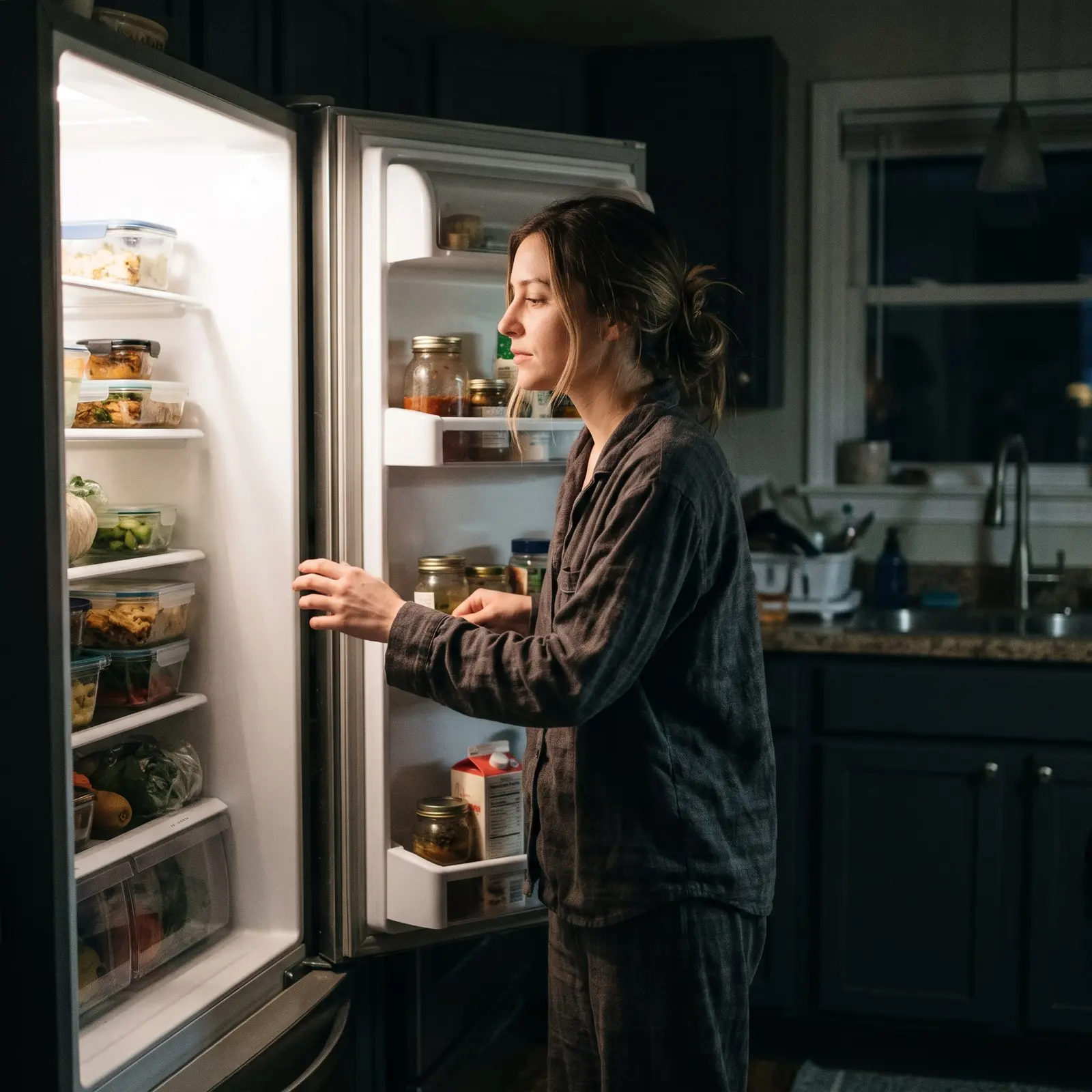
Practical tips to enjoy sweets and still sleep well
You don't have to give up dessert. These are small experiments, not rules, so pick one or two and notice how your nights feel.
Have dessert earlier. Moving dessert closer to dinner is a simple way to test whether timing matters for you.
Lean on whole fruit and fiber. Reach for a piece of whole fruit or a fiber-rich snack instead of candy or juice.
Keep portions easy. A few squares of chocolate bring less caffeine than a whole bar, since chocolate's caffeine adds up by the ounce [5].
Try a one-week snack check. Jot down what you eat after dinner, what time, and how you slept. A week of notes can show you your own pattern.
How much time should you leave between sugar and bedtime?
There's no proven cutoff. A few hours between dessert and lights out is a reasonable thing to test for yourself, and your one-week snack check will tell you more than any rule.

How much sugar in the evening is too much?
We didn't find a study that names an evening sugar limit for sleep, so we won't invent one. The research looks at your overall eating pattern instead, which we covered above.
Will your sleep get better if you cut out sugar?
We didn't find a trial that tested cutting out sugar to see what happens to sleep. Since the studies so far show links, small and steady changes you can keep make more sense than cutting things out.
Better late-night snacks than something sugary
If you're truly hungry before bed, it's okay to eat. Lying awake with a growling stomach isn't restful either.
A small fiber-rich snack, like pear slices with whole-grain crackers, is a good pick.
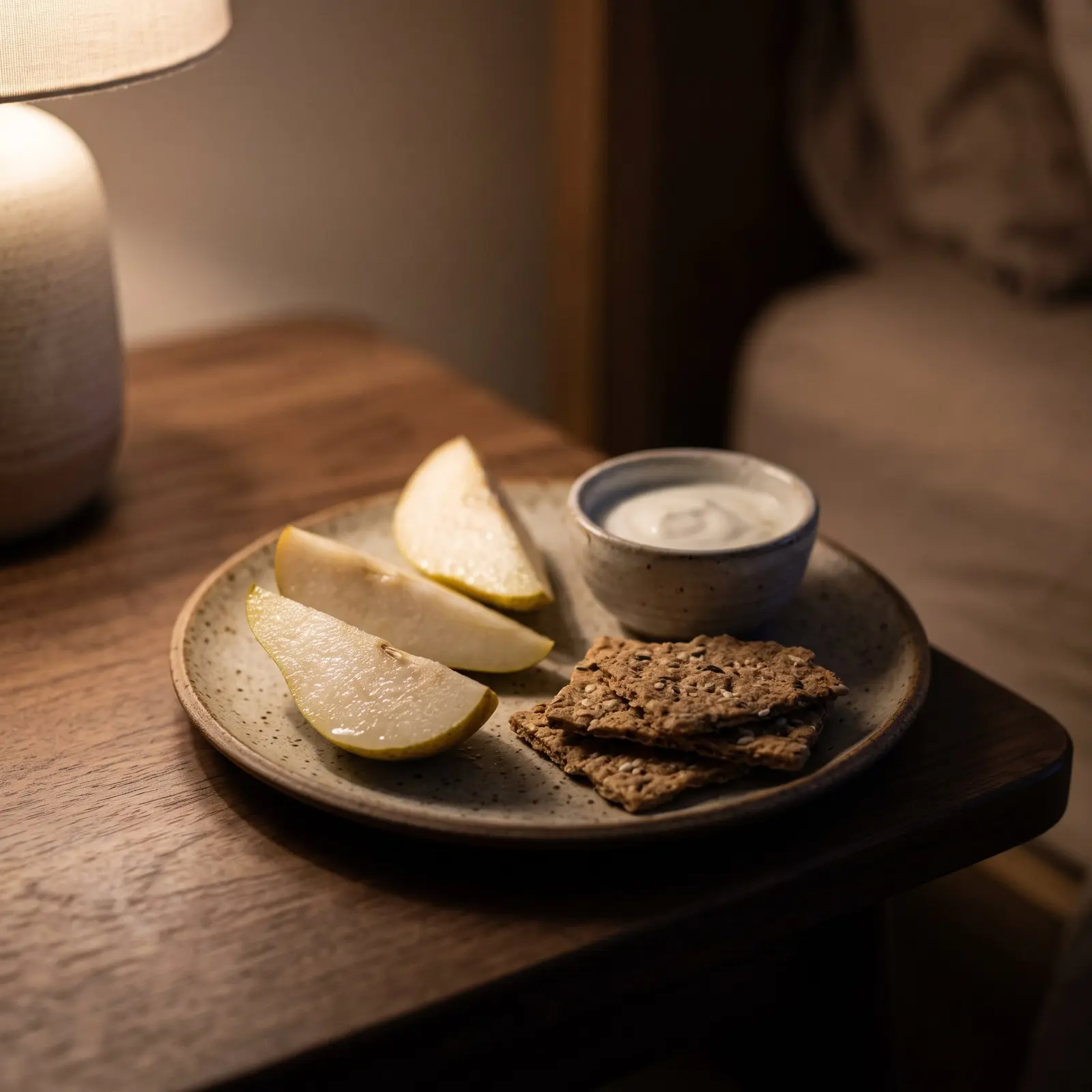
A calm evening, from dinner to lights out
Habits matter too. A steady wind-down gives your evening a clear shape, and our guide to winding down goes deeper on why.
Your sample evening
- 4 hours before
Dinner, with dessert if you like
Eat at your usual pace and enjoy it.
- 3 hours before
Switch to caffeine-free
Set aside cola, iced tea and chocolate from here on, or choose caffeine-free versions.
- 90 minutes before
Start winding down
Dim the lights, tidy up and shift to quieter things.
- 1 hour before
A warm, caffeine-free drink
A cup of chamomile tea makes a soothing little ritual.
- 30 minutes before
Settle in
Read, stretch gently or jot down tomorrow's to-dos so your mind can rest.
- Bedtime
Lights out
Keep the same bedtime most nights so your evenings feel familiar.
Shift the times to fit your life. The point is a routine you can repeat, night after night.
Easing stress before bed
Since one leading idea ties sugar swings to stress hormones, it's worth easing the other stresses in your evening too [1]. A few slow breaths, a short walk after dinner or a quiet hobby can help you shift gears. If racing thoughts are what keep you up, our piece on why you can't turn off your mind at night walks through it.
Chamomile and L-theanine: two calming ingredients
Two ingredients come up a lot when you read about calm evenings: chamomile and L-theanine. Both have early research worth knowing.
Chamomile: the classic bedtime flower
Chamomile was an important medicinal herb in ancient China, Egypt, Greece and Rome, and today it's widely promoted for calm and sleep [6].
In a review of 12 small randomized trials, chamomile was linked to better sleep quality [7]. The studies so far are small, very little research has looked at chamomile for insomnia, and the authors call for larger trials [6][7].
L-theanine: calm without drowsiness
L-theanine is an amino acid from tea leaves. It has been reported to help you relax without making you sleepy [8].
A 2025 review of 13 trials with 550 people concluded it appears to be a safe and effective way to support healthy sleep in adults [8]. The trials so far are small, and larger studies are needed.
Frequently asked questions
How long does sugar keep you awake?
No study we found measured how long sugar itself keeps you awake. If a sweet snack seems to keep you up, your one-week snack check can show whether it's the timing or hidden caffeine.
Safety notes and when to see a doctor
Food is only one piece of sleep. Some signs point to something worth checking, and asking about them is a normal, smart step.
Bring your one-week snack and sleep notes along. They give your doctor real details to work with.
References
- The Effects of Dietary Nutrition on Sleep and Sleep Disorders. PubMed Central (NIH), peer-reviewed review.↩
- High glycemic index and glycemic load diets as risk factors for insomnia: analyses from the Women's Health Initiative (Gangwisch et al., Am J Clin Nutr 2020). PubMed (NIH).↩
- Fiber and Saturated Fat Are Associated with Sleep Arousals and Slow Wave Sleep (St-Onge et al., J Clin Sleep Med 2016). Journal of Clinical Sleep Medicine (AASM).↩
- Sleep curtailment in healthy young men is associated with decreased leptin levels, elevated ghrelin levels, and increased hunger and appetite (Spiegel et al., 2004). PubMed (NIH).↩
- Caffeine in the diet. MedlinePlus (NIH).↩
- Chamomile: Usefulness and Safety. NCCIH (NIH).↩
- Therapeutic efficacy and safety of chamomile for state anxiety, generalized anxiety disorder, insomnia, and sleep quality: systematic review and meta-analysis (Phytother Res 2019). PubMed (NIH).↩
- Examining the effect of L-theanine on sleep: a systematic review of dietary supplementation trials (Cotter et al., 2025). PubMed (NIH).↩
These statements have not been evaluated by the Food and Drug Administration. This product is not intended to diagnose, treat, cure, or prevent any disease.



Comments
Sign in to join the conversation.
No comments yet. Be the first.