


How long should it take you to fall asleep?
If you lie awake wondering how to fall asleep faster, start with a fair goal. The time it takes you to drift off has a name: sleep latency, the minutes between getting into bed and falling asleep [3].
Cleveland Clinic gives a similar range of about 10 to 20 minutes, and calls it a guide, not a strict rule [3]. So a few extra minutes now and then doesn't mean something is wrong.
What happens as you drift off
Falling asleep is the first step of a cycle your brain repeats all night. Here are the stages of sleep, in order.
The first of three non-REM (non-rapid eye movement) stages: the shift from awake to asleep. This is the step you want to reach sooner. [1]
Non-REM sleep deepens. Stage 3, deep or slow-wave sleep, fills more of your early night. [1]
REM, short for rapid eye movement, is the other main type of sleep. It's when most dreaming happens, and it rounds out the cycle. [1]
The whole cycle repeats, usually four to six times a night. [1]

Why falling asleep can take so long
When sleep drags, there's usually more than one thing in the way. Each of these has a change you can try tonight.


Your schedule keeps shifting
Different bedtimes, or sleeping in on weekends, leave your body guessing.
Caffeine is still working
Caffeine and nicotine take hours to wear off, so an afternoon coffee can still be with you at bedtime.
Your room isn't ready
A warm, bright or noisy room, or a screen in your hand, works against you at bedtime.
You're on alert
Tight muscles, a busy head and glances at the clock all add stress. Clock-watching makes sleep harder to reach.
If thoughts are what keep you up, read why your mind won't switch off at night.
How to sleep faster and better: your evening, step by step
Good nights start in the daytime. Have your last caffeine by noon [5]. Regular exercise helps too, just not too close to bedtime [5].
Your wind-down, counting back from bedtime
- 4 hours before
Last drink, if any
Keep alcohol to one drink, at least four hours before bed.
- 2 to 3 hours before
Finish dinner
Leave a couple of hours between a big or heavy meal and bed.
- 1 hour before
Screens down, lights low
Put your phone away and switch to soft lamps. A book or quiet music fills the hour gently.
- 30 minutes before
Ready the room
Make it cool, dark and quiet. Turn the clock so you can't see it from bed.
- 15 minutes before
Let your body unwind
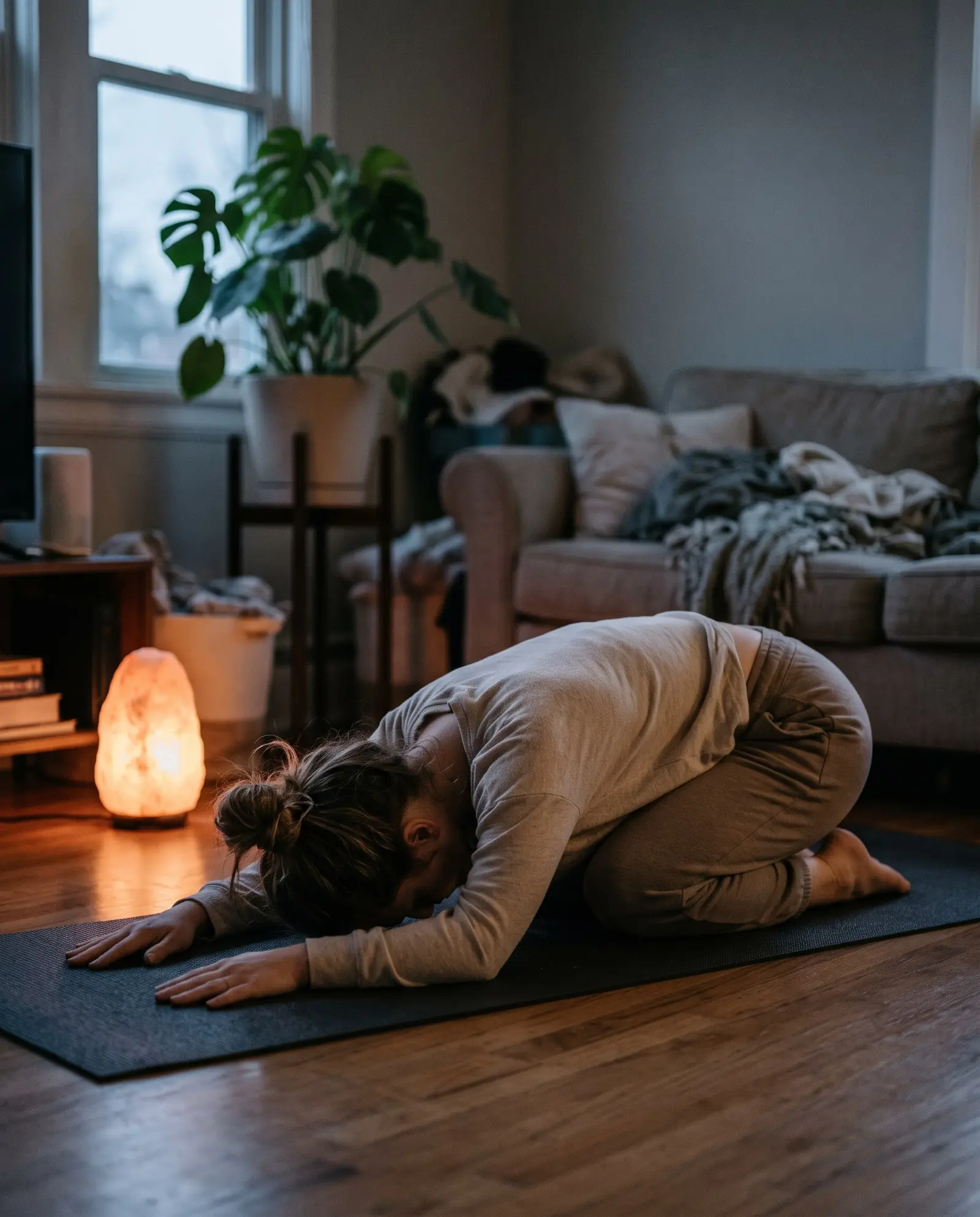
Try a few slow, easy yoga poses to ease tension. Keep it soft, not a workout.
- Bedtime
Lights out
Same time as last night, with the same wake time tomorrow.
For more ideas to fill that last hour, our bedtime routine guide builds it out. Dinner is part of your evening too, so see how your food affects your sleep and whether sugar keeps you awake.
When sleep won't come
Instead of waiting it out, give yourself something to do. The second option is a simple rule from Mayo Clinic for nights when you can't drift off. For busy-brain nights, see how to calm a racing mind.

Two ways to settle when sleep won't come
Choose the one that fits your night.
Progressive muscle relaxation
Tense one muscle group, like your hands or shoulders, for a few seconds, then let go. Move slowly from your feet to your face. It can ease tension and help tight muscles relax.
- Where
- In bed or in a chair
- Source
- Mayo Clinic
The 20-minute reset
Not asleep after about 20 minutes? Leave the bedroom, do something relaxing, and go back to bed when you feel tired.
- When
- After about 20 minutes awake
- Source
- Mayo Clinic
What research says about sleep ingredients
Habits come first. But if you're curious about supplements, here's where the most common sleep ingredients stand, in plain terms.

Melatonin
A 2022 review of 12 studies with 2,666 participants found it helped those with insomnia fall asleep faster, though overall sleep quality didn't change. It may also help when jet lag or shift work throws you off.
Magnesium and vitamin B6
Both support normal muscle and nervous-system function. Magnesium's link to sleep is a bigger story of its own.
Chamomile, lemon balm, passion flower
These plants are traditionally used in evening teas to help you unwind. The research on them for sleep is still early.
Go deeper with magnesium for sleep, when to take melatonin, or our ingredient-by-ingredient guide.

Sleep myths that can slow you down

Falling asleep fine but dragging through the day? That's a different puzzle, and why you feel tired all day can help you sort it out.
Frequently asked questions
What is a good 5-minute sleep meditation to fall asleep fast?
Try the tense-and-release muscle method above. One slow round, from your feet to your face, fits easily into five minutes.
What is the Japanese trick to sleep?
We couldn't find a trusted source that names one, so we can't vouch for it. The steps in this guide are the ones with real backing.
What will knock me out to sleep?
Nothing switches sleep on like a light, and you don't need it to. The wind-down steps above make it easier for sleep to come on its own.
Do weighted blankets help you fall asleep?
In the main trial, 120 outpatients with insomnia in Stockholm, all under psychiatric care, slept under either an 8-kg weighted blanket or a light 1.5-kg one. It's one study in a narrow group, so it can't tell you much yet about your own nights.
Safety notes and when to see a doctor
Supplements aren't right for everyone. Here's what to know before you try one.
References
- How Sleep Works - Sleep Phases and Stages. NHLBI (NIH).↩
- How Long Should It Take to Fall Asleep? Sleep Foundation.↩
- What Is Sleep Latency? How It Impacts Sleep. Cleveland Clinic.↩
- Sleep tips: 6 steps to better sleep. Mayo Clinic.↩
- Insomnia: How do I stay asleep? Mayo Clinic.↩
- Sleep Disorders and Complementary Health Approaches: Usefulness and Safety. NCCIH (NIH).↩
- Melatonin: What You Need To Know. NCCIH (NIH).↩
- Paying attention to the sleeping surface and bedclothes (commentary on Ekholm et al. 2020). Journal of Clinical Sleep Medicine (AASM).↩
These statements have not been evaluated by the Food and Drug Administration. This product is not intended to diagnose, treat, cure, or prevent any disease.



Comments
Sign in to join the conversation.
No comments yet. Be the first.