


Why can't I turn off my mind at night?
All day, your brain has tasks, talk and noise to keep it busy. Then you lie down in the dark, and for the first time it has nothing else to do.
If your day was stressful, your mind may keep working on problems after the lights go out. The quiet gives it room to replay everything you didn't finish.
So yes, it's normal to overthink more at night than during the day.
Your mind isn't broken. It's just finally been given the floor.
It's worth a look at your own day: your coffee, your naps and how much you moved.

Caffeine, extra sleep and a body that isn't tired
Caffeine close to bedtime can keep your brain alert, so the NHLBI suggests avoiding it near bed [1]. If your nights feel wired, your coffee habit is a good place to start looking.
Extra sleep at the wrong time matters too. The NHLBI suggests avoiding naps, especially in the afternoon, since that may help you sleep longer at night [1].
And movement helps your body feel ready for rest. Be active during the day, at least 5 to 6 hours before bed, because exercising close to bedtime can make it harder to fall asleep [1].
What keeps your brain switched on in the evening
A few evening habits can quietly keep your mind on alert. Here's what the NHLBI points to [1]:
How to turn off your brain so you can sleep
You can't force your mind to go quiet. But you can give it fewer reasons to stay up, starting about an hour before bed.

Set a wind-down window
Pick a time each night when your day officially ends. Dim the lights, put work away and choose something slow, like reading, soft music or a hot bath [1].
Our guide to the science of winding down goes deeper.
Get it out of your head and onto paper
Early in your wind-down, write tomorrow's to-do list and any worry that keeps circling. It gives your brain a place to set the plan down until morning.
Skip the revenge scrolling
Revenge scrolling means staying up late on your phone to win back time the day took from you. It can feel like the only time that's yours. But the NHLBI suggests keeping screens out of the bedroom, so try charging your phone in another room [1].
Make your room, or your hotel room, feel like night
A dark, cool, quiet room gives your brain fewer things to notice. When you travel, pack a cue from home, like your own pillowcase or an eye mask.
A sample 60-minute bedtime routine for a busy mind
- 60 min before bed
Lights down, day done
Dim the lamps, close the laptop and charge your phone outside the bedroom.
- 50 min before bed
Write it down
Jot tomorrow's to-do list and any worry on your mind. Then close the notebook.
- 40 min before bed
Something warm and slow
Take a hot bath, read a few pages or play soft music.
- 20 min before bed
Breathe it out
Breathe in for four and out for six for a few minutes.
- 10 min before bed
Bed when you're sleepy
Head to bed once your eyes feel heavy, and keep the bed for sleep.
- Bedtime
Lights out
Let thoughts come and go. If you're still wide awake, get up and try again later.
How to shut your brain off from overthinking
Sometimes your thoughts don't race so much as spin, the same worry on repeat. Here's how to stop spinning thoughts when they won't let go.
Give worry its own appointment
Set aside a short block in the late afternoon as your worry time. Write what's bugging you and one next step for each, so bedtime isn't the first time your worries get heard.
If you wake at 3am and your mind starts racing
Wrestling a thought in the dark usually keeps it loud. The NHLBI's advice is simple: go to bed only when you're sleepy, and get out of bed if you can't sleep [1].
Move to a dim spot, read something calm or write the worry down, then come back when your eyes feel heavy. The NHLBI also suggests using your bed only for sleep and sex [1].
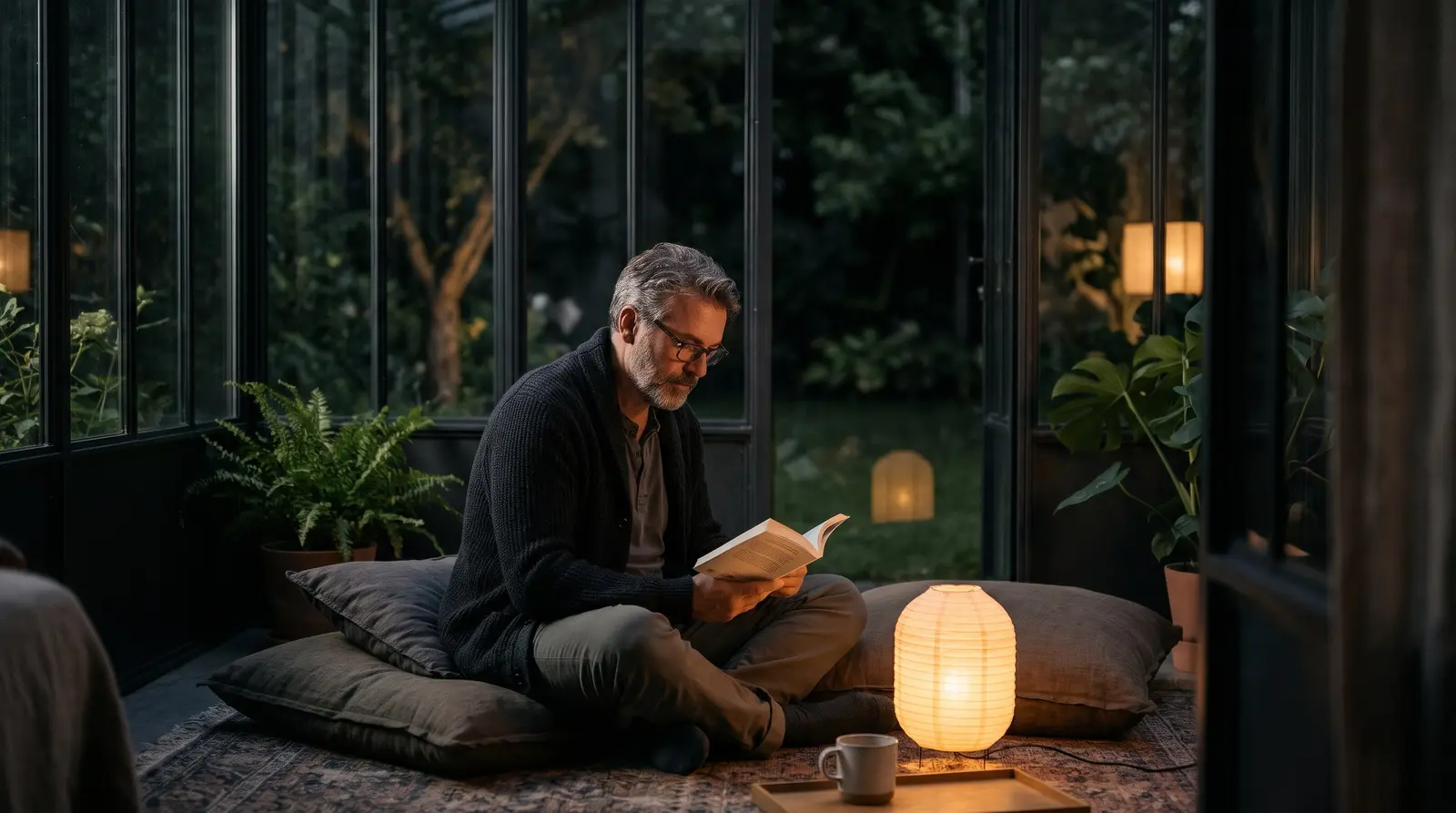
Where magnesium, 5-HTP and calming botanicals fit your evening
Some nutrients and plants have a long history in evening routines. Here's what each one does and what research has found so far.
Magnesium glycinate: what it is and what research shows
Magnesium glycinate is magnesium bound to glycine, an amino acid.
Magnesium supports muscle relaxation and your nervous system. A 2021 review of three small, low-quality studies suggests it may help older adults with insomnia fall asleep faster, and larger trials are still needed [2].
5-HTP: a building block for serotonin
5-HTP is a building block your body turns into serotonin. In supplements, 5-HTP can come from the seed of a plant called Griffonia simplicifolia. Research on 5-HTP for sleep is still very limited.
Your body changes 5-HTP into serotonin.
5-HTP supports normal serotonin levels.
Serotonin is the starting material your body uses to make melatonin, the signal tied to your sleep cycle.
Calming plants and what research shows

Calming plants at a glance
Chamomile
A medicinal herb in ancient China, Egypt, Greece and Rome. A 2019 review of 12 small trials found it improved sleep quality.
Lemon balm
A lemon-scented mint that shows promise as a calming agent.
Passion flower
Traditionally used as a sedative, and research suggests it might improve total sleep time.
L-theanine
An amino acid from tea leaves. Reviews of human trials conclude it can support aspects of sleep quality.
Reishi
A mushroom used in traditional Chinese medicine for health and vitality.
Frequently asked questions
What does the word "insomnia" mean?
Insomnia means trouble falling asleep, staying asleep or getting restful sleep, even when you have the chance.
What part of sleep does L-theanine support?
Reviews of human trials found its benefits show up most in sleep quality, meaning how rested your sleep feels, more than in how long you sleep.
Can lemon balm help my sleep?
A review of the research suggests lemon balm may improve sleep quality, though stronger trials are still needed.
Safety notes and when to see a doctor
A busy mind now and then is part of being human. But some patterns deserve real support, and asking for it is a strong move.
Racing thoughts vs. looping, intrusive thoughts
Racing thoughts jump from one thing to the next. Intrusive thoughts are unwanted ones that stick, sometimes with an urge to check or repeat something to feel okay.
If your thoughts feel stuck like that, a doctor or therapist can help you sort out what's going on.
If worry about sleep itself starts to grow, that's worth bringing up too.
References
- Insomnia Treatment. NHLBI (NIH).↩
- In the News: Magnesium Supplements for Sleep Disorders. NCCIH (NIH).↩
- Effects of L-theanine on cognition, mood and sleep: evidence from human trials. PMC (peer-reviewed review).↩
- Clinical Efficacy and Tolerability of Lemon Balm (Melissa officinalis L.) in Psychological Well-Being: A Review. PMC (peer-reviewed review).↩
- Passionflower: Usefulness and Safety. NCCIH (NIH).↩
- Chamomile: Usefulness and Safety. NCCIH (NIH).↩
- Therapeutic efficacy and safety of chamomile for state anxiety, generalized anxiety disorder, insomnia, and sleep quality: A systematic review and meta-analysis. Phytotherapy Research (PubMed).↩
- Lingzhi, Reishi (LiverTox). NIH LiverTox / NCBI.↩
These statements have not been evaluated by the Food and Drug Administration. This product is not intended to diagnose, treat, cure, or prevent any disease.



Comments
Sign in to join the conversation.
No comments yet. Be the first.