

Why anxiety makes your heart race at night
You're lying still, the house is quiet, and suddenly your heart is thumping hard. It can feel alarming.
But once you see what's going on in your body, it starts to make a lot more sense. And when it makes sense, it gets a little less scary.

Stress and worry put your body into a ready-to-act state. That works against the slow, natural wind-down your evening needs.
That alert state is often called fight or flight. It's built for short bursts, like jumping back from a curb, but a worried mind can switch it on while you're lying in bed.
Three reasons your heartbeat feels louder after dark


Nothing else to notice
With no screens, talk or chores pulling your focus, you're more likely to notice your heartbeat.
You're closer to every beat
Lying still, each beat is easier to feel.
The day's leftovers
An afternoon coffee or an evening cigarette sits closer to bedtime than it feels.
Put these together and you get a loop.
A worried mind switches on your body's ready-to-act state.
Anxiety, stress and fear are known causes of palpitations. [1]
Without distractions, the beat feels bigger. [2]
Watching your heart closely adds stress, which feeds the loop. [1]
The good news is that you can step in at any point in that loop. A slower breath, a new position or a calmer evening each breaks one link.
If nights are when your worry peaks in general, our guide on why anxiety gets worse at night goes deeper.
What heart palpitations at night feel like
Palpitations are the feeling that your heart is pounding or racing. You can feel them in your chest, and sometimes in your throat or neck [1].
Cleveland Clinic describes them as pounding, fluttering, a skipped beat or a little flip in your chest [2]. A palpitation is a feeling, not a diagnosis. It tells you that you noticed your heart, not what's behind it.
At night, it tends to show up in one of a few ways: a jolt that wakes you, a steady thud as you try to drift off, or a fluttery skip that comes and goes.
What can be mistaken for a heart palpitation
Not everything that feels like a palpitation is your heart doing something new.
Palpitation or a normal heartbeat?
Three things that can feel alike at 2 a.m., and how they differ.
A normal heartbeat you suddenly notice
Your heart beats all day, but you rarely feel it. In a still, dark room, a steady, regular beat can seem loud even when nothing has changed.
- Feels like
- Even and regular
- When you notice it
- Lying still, few distractions
Hearing your heartbeat on the pillow
With your ear pressed to a pillow, you may hear a soft thump or whoosh. Cleveland Clinic notes that when your heart pounds, you may even hear it beating in your ears.
- Feels like
- A sound more than a feeling
- What to try
- Your back or your other side
The occasional early beat
An early beat can feel like a skip or a flip. Doctors call these PVCs or PACs, short names for beats that start a little early in the lower or upper chambers of your heart.
- How common
- Nearly everyone has them now and then (Cleveland Clinic)
- Felt by
- Some, not all
Knowing which one you're feeling can take some of the fear out of it. A steady beat you can hear is very different from a racing one that won't settle.
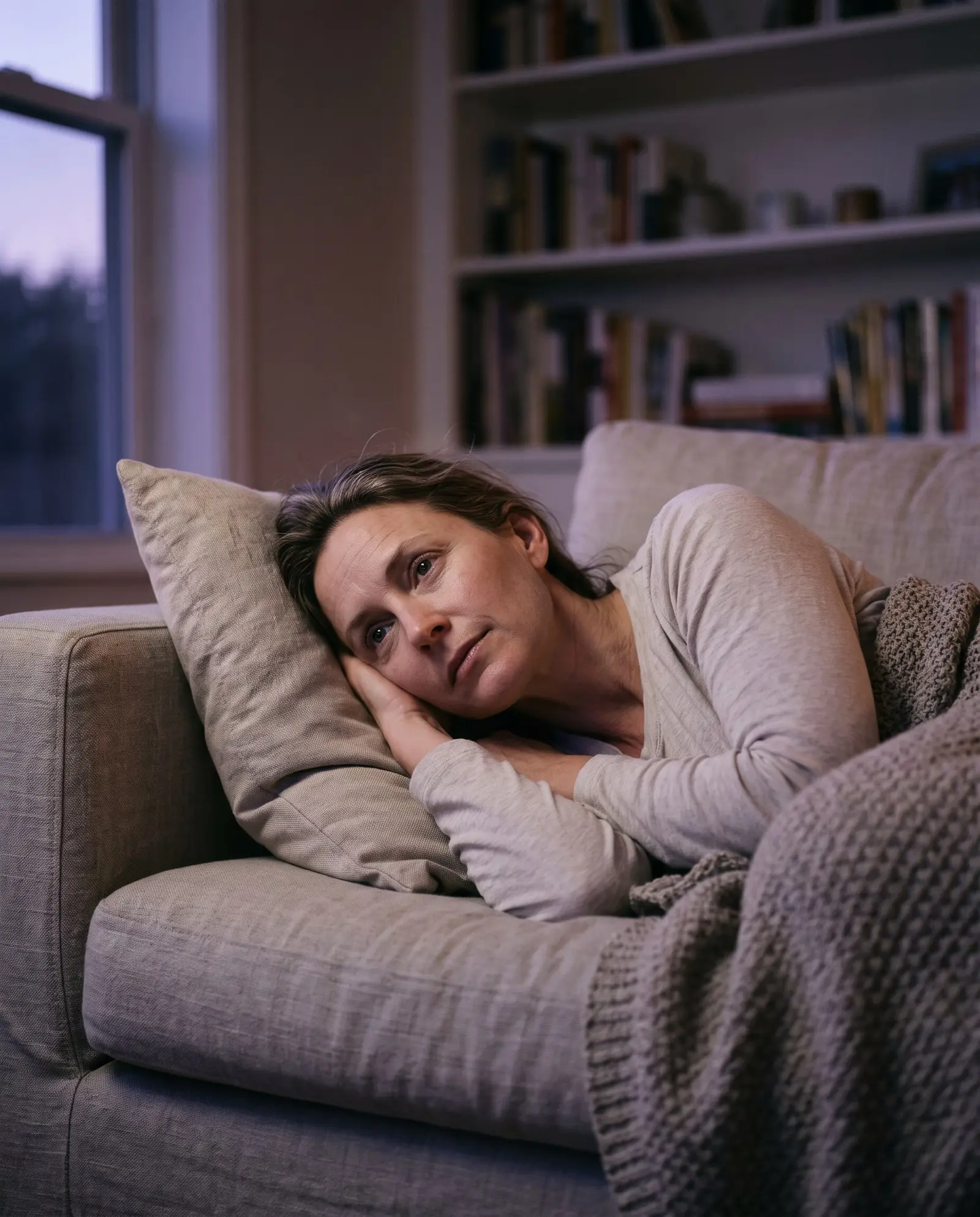
Non cardiac palpitations: when the cause isn't your heart
You may come across the term non-cardiac palpitations. It simply means the feeling comes from something outside your heart, like stress, fear, caffeine or nicotine [1].
That's why anxiety is such a common thread. MedlinePlus says palpitations are not serious most of the time [1]. That doesn't make them pleasant, but it can make them a little less frightening.
So a heartbeat in the 90s while you're wound up can still sit inside that normal range. Knowing the number helps you read your body with a little more calm.
If bedtime itself has started to feel tense, our piece on sleep anxiety looks at why that happens and how to soften it.
Heart racing when bending over
Maybe you feel your heart pick up when you bend to tie a shoe or lift a laundry basket. It's a fair thing to wonder about.
Here's what the trusted sources tell us. Position can play a part. Cleveland Clinic notes that sleeping hunched over on your side can raise pressure inside your body and bring on palpitations [2].

So, should your heart rate increase when you bend over? Bending and curling both fold your body in on itself, so it's worth noticing whether your palpitations show up in those moments.
But we didn't find a clear rule in our sources for how much your heart rate should change when you bend, so we won't guess at a number for you.
Non cardiac palpitations bending over
If stress is behind most of your palpitations, a bend may simply be the moment you happen to notice one. Write down when it happens, what you were doing and how long it lasted.
The night log further down gives you an easy way to track that. The safety notes at the end cover when it's worth getting checked.
What to do in the first 2 minutes after waking with a pounding heart
Waking with a thudding heart is jarring. Your first instinct may be to lie very still and listen.
But moving and breathing give your body something better to do. Here's a simple plan for those first two minutes.
Your first two minutes
- 0:00
Sit up
Swing your legs over the side or prop yourself up. Changing position is one of Cleveland Clinic's first suggestions.
- 0:15
Make your breath out long
Breathe in through your nose, then out slowly through pursed lips.
- 0:45
Roll or reset
If sitting doesn't feel right, roll onto your other side and keep the long breaths going.
- 1:15
Take a short walk
A slow lap around the room while you breathe deeply is another step Cleveland Clinic suggests.
- 1:45
Let it be
Notice the beat, then gently move your attention to your breath or one calm word.
Two minutes won't always be enough, and that's okay. The aim isn't to force your heart to slow on command.
It's to stop adding fuel. Every calm breath is one less signal telling your body it's in danger.
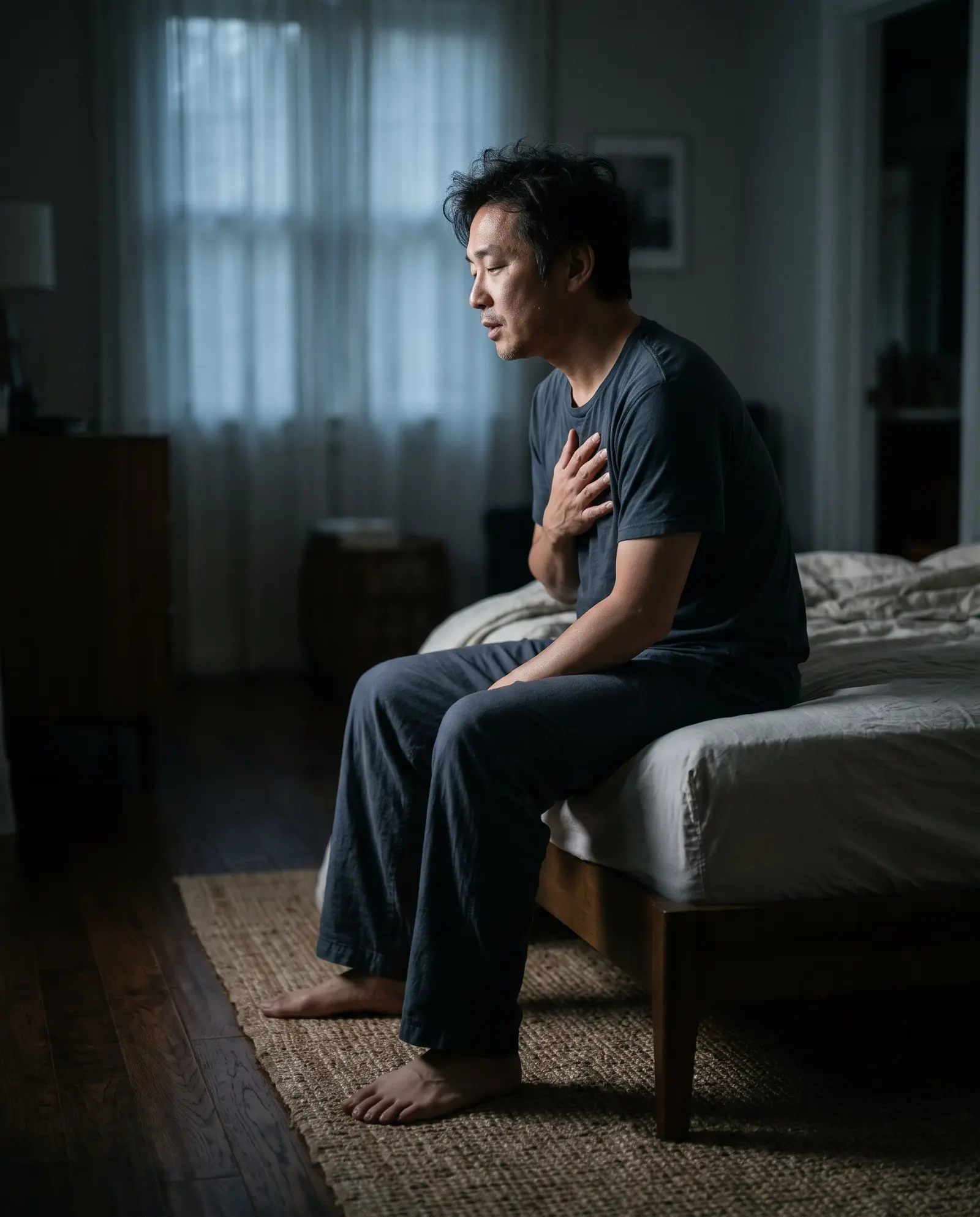
How to stop heart palpitations due to anxiety at night, one breath at a time
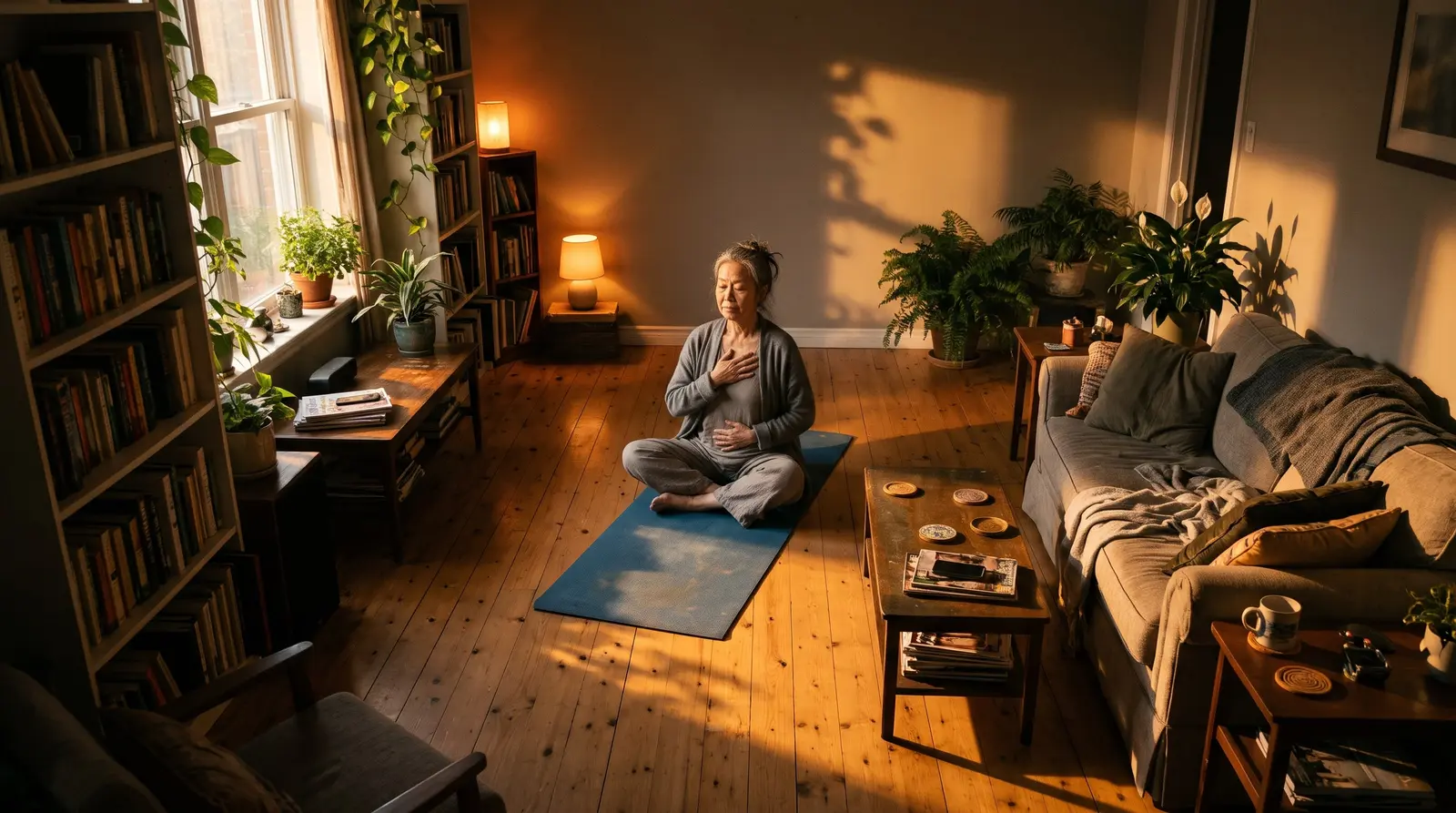
Your heart rate isn't something you can push down with willpower. But you can give your body calm signals, and the most dependable one is your breath.
Take deep, slow breaths
MedlinePlus lists deep relaxation and breathing exercises as home care for palpitations [1]. Cleveland Clinic points to pursed-lip breathing: a long breath in through your nose, then a slow breath out through lips shaped as if you're about to whistle [2].
The breath out is the part to lean on. Make it a little longer than your breath in, and keep it gentle rather than forced.

Vagus nerve heart palpitations and vagal maneuvers
You may come across vagal maneuvers online. They're simple moves meant to work through the vagus nerve, a long nerve that links your brain with your heart and gut and is part of how your body slows down.
Slow breathing, with a long, gentle breath out, is the easy place to start.
Slow movement and stillness
Beyond breathing, MedlinePlus suggests yoga, meditation and tai chi [1]. Each pairs slow movement or stillness with steady breaths, which gives an alert body a clear cue to ease off.
You don't need a class. Five minutes of slow stretching, or sitting with your eyes closed while you count your breaths, counts.

Avoid stimulants and evening triggers
What you take in during the day shows up at night. MedlinePlus notes that cutting back on caffeine, nicotine and other stimulants will often reduce heart palpitations [1].
Move your last coffee earlier. Tea, energy drinks and many sodas carry caffeine too, so count them in.
Ease off nicotine in the evening, vapes included.
Keep a steady bedtime. Going to bed and waking near the same times helps your body learn when to wind down.
Give worry its own time slot. Jot down tomorrow's to-dos before dinner, so they aren't waiting for you in bed.
Dim the lights in your last hour, and keep your phone out of arm's reach.

Best sleeping positions to quiet your heartbeat
How you lie at night is worth a look. There isn't one perfect position.
Your goal is the position where you notice your heart least. Try each of these for a few nights.

Three ways to lie down on a racing-heart night
See which one feels calmest for you.
Hunched on your side
Knees tucked and shoulders rounded feels cozy, but it folds your body in. If you often wake with a pounding heart, this is the first habit to change.
- Try instead
- Straighten your legs a little
Long and open, on your side or back
Lengthening your body keeps it from folding in on itself. On your back, your ear is off the pillow too, so you hear less of each beat.
- Small tweak
- A pillow between your knees
Sitting up a little
A couple of pillows behind your back lifts your upper body. Some nights, this is the easiest place to do your slow breathing before you lie flat again.
- Good for
- The first minutes after waking
A 5-minute wind-down for racing-heart nights
On nights when you can feel your heart before you even lie down, a short, set routine gives your body a clear cue. Here's a five-minute version for right before lights out.
Five minutes to a calmer bedtime
- 5 minutes before
Set the day down
Put your phone across the room and write any lingering to-do on paper.
- 4 minutes before
Lower the lights
Switch to one soft lamp, so the room feels like evening.
- 3 minutes before
Sit and breathe
Sit on the edge of the bed. Breathe in through your nose and out slowly through pursed lips, about six times.
- 1 minute before
Soften your body
Drop your shoulders, unclench your jaw and loosen your hands, one area at a time.
- Bedtime
Lie down, open
Stretch out on your back or side and let your attention rest on your breath instead of your pulse.
Manage stress before bed, starting in your day
The alert state we talked about earlier doesn't switch off when you brush your teeth. If stress has built all day, it tends to come to bed with you.
That's why calm habits in daylight count. A short walk at lunch, a few slow breaths between tasks, or a real break from your screen gives your body more chances to step down from alert.
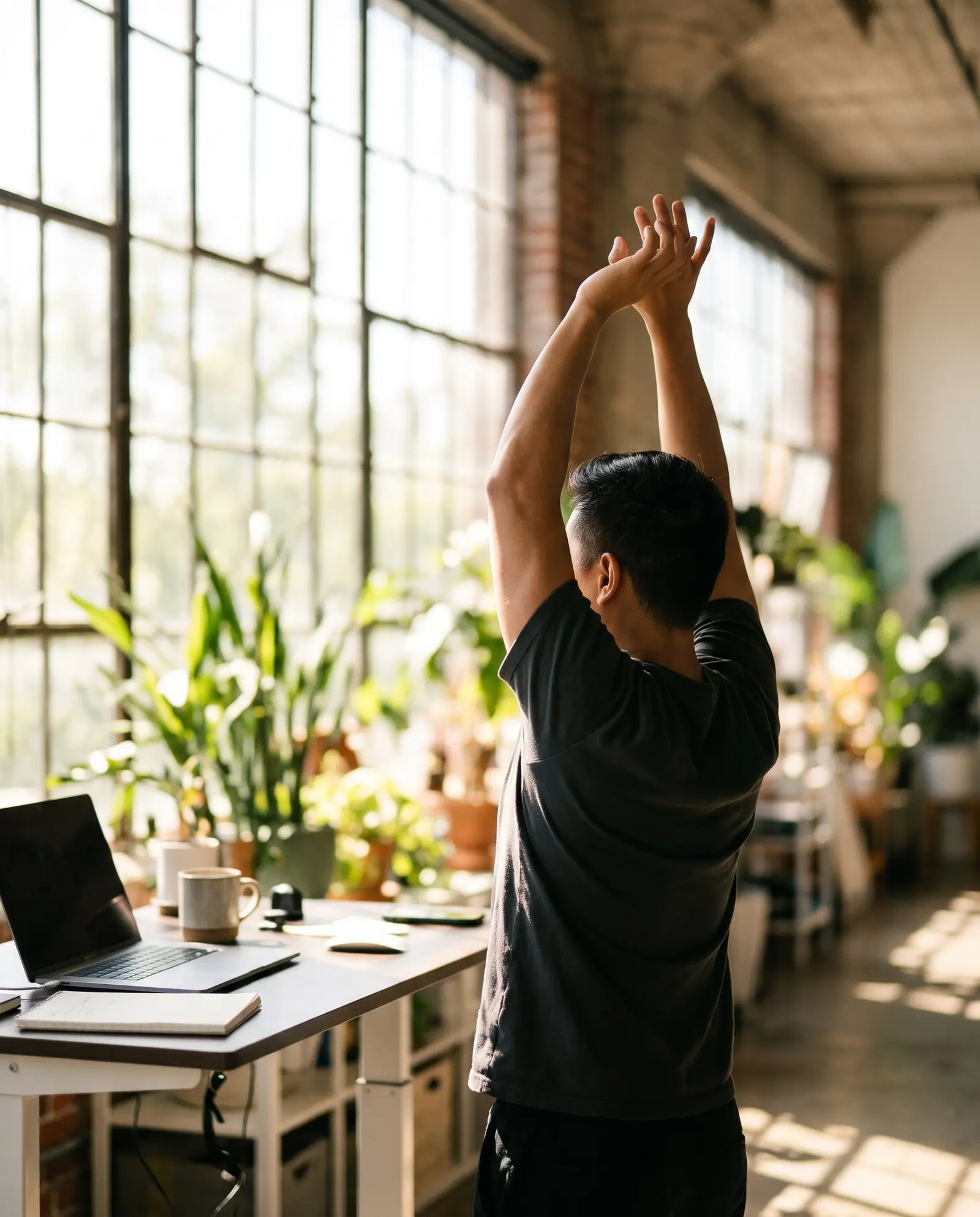
In the evening, build a buffer between the busy part of your day and bed. Even 20 minutes of something slow, like a bath, a book or gentle stretching, marks the shift.
If your thoughts are the loudest part of the night, our guide to calming a racing mind, day and night has more ways to quiet them.
Identifying triggers with a simple night log
Patterns are hard to see from inside a rough night. A simple log, kept for a week or two, can show you what your palpitations have in common.

| What to note | Example | Why it helps |
|---|---|---|
| When it started | 2:40 a.m. | Shows whether it's falling asleep or waking mid-night |
| What you were doing | Curled on your left side | Links it to your position or a bend |
| How it felt | Pounding, about a minute | Separates a racing beat from a skip or flutter |
| Caffeine and nicotine | Coffee at 4 p.m. | Spots stimulant patterns |
| Your stress that day | Big deadline, skipped lunch | Connects daytime stress to your night |
| What helped | Sitting up, long breaths out | Builds your own go-to plan |
Keep it by your bed with a pen, or fill it in the next morning if writing at night wakes you more. Seeing your patterns on paper can make the next night feel less mysterious.
Calming ingredients research looks at for stress and evening calm
When stress is part of your racing-heart nights, you may wonder about calming ingredients. These aren't for your heartbeat itself.
Their place is supporting a healthy response to stress and an easier wind-down. Here's what each one is and where the research stands.
Ashwagandha
Ashwagandha has been used as a medicinal plant for thousands of years, especially in Ayurvedic medicine [3]. Its species name, somnifera, means sleep-inducing, a hint at its long link with rest.
It contains withanolides, natural compounds associated with anti-inflammatory and antioxidant effects [3]. NCCIH says some preparations may help with sleep and stress, though many studies were small and used different preparations [3].
The evidence on anxiety itself is less clear so far [3]. So its place is supporting a healthy response to stress, as one part of a calmer evening.
Magnesium and vitamin B6
Magnesium is a mineral and vitamin B6 is a B vitamin, and both support normal muscle and nervous-system function.
Research on magnesium for sleep is limited and mixed, and most studies are small. For vitamin B6, its role in making brain messengers is well known, but direct evidence that B6 supplements improve sleep is limited.
L-theanine and lemon balm
L-theanine is an amino acid from tea leaves, associated with relaxed alertness: calm without feeling drowsy. Small trials suggest it may support stress and sleep quality, though larger studies are needed.
Lemon balm is a lemon-scented member of the mint family, traditionally used to calm the nerves. It's thought to support GABA, your brain's main slow-down messenger.
For lemon balm, human trials so far are small.
Reishi
Reishi is a mushroom used for centuries in East Asian tradition as a tonic. Most of its research so far is in animals and small human studies.
Frequently asked questions
Can anxiety cause heart palpitations?
Yes. Cleveland Clinic notes palpitations are common during a panic attack, a sudden rush of intense fear.
Can a glass of wine or a bit of chocolate after dinner set them off?
They can for you. Cleveland Clinic names alcohol and chocolate, along with caffeine, as food and drink triggers. Your night log is the simplest way to see whether they matter for you.
Does drinking water help a racing heart?
It can if you're dehydrated. When you're low on fluids, your heart has to work harder to pump blood, so Cleveland Clinic suggests drinking water. A glass on your nightstand makes it an easy step.
Safety notes and when to see a doctor
Most palpitations don't need a trip to the emergency room [1]. But some signs need help right away, and some are worth a planned visit.
When to worry about heart palpitations
See your provider if any of these fit you. MedlinePlus says to contact your provider right away for frequent extra beats or a resting pulse over 100.
You've never had palpitations before [1].
They happen often while you're resting or lying down [2].
You often feel extra beats, more than 6 a minute or in groups of 3 or more [1].
Your resting pulse is over 100 without exercise, anxiety or fever [1], or a fitness device alerts you to a heart rate over 100 [2].
Your palpitations suddenly increase or change [1].
You have risk factors for heart disease, such as high cholesterol, diabetes or high blood pressure [1].
What a doctor may check
Your doctor may start with an electrocardiogram (ECG or EKG), a quick test that records your heart's electrical signals [1]. Because an ECG can miss palpitations that come and go, you may wear a Holter monitor, a small recorder, for up to a week [2].
Blood tests can check for things like anemia or thyroid problems [2]. Bring your night log, since it answers questions your doctor will ask, like whether it happens when you're lying down or when you change position [1].
Supplement cautions
Supplements don't replace a check-up for palpitations. If you're considering a sleep or calm supplement, keep these in mind:
Ashwagandha may cause drowsiness, stomach upset, diarrhea or vomiting [3]. Avoid it if you're pregnant or breastfeeding, before surgery, or if you have an autoimmune or thyroid condition [3].
Ashwagandha may interact with medicines for diabetes, blood pressure, thyroid, seizures and immune suppression, and with sedatives [3]. Rare cases of liver injury have been reported, and it may be safe short term, up to 3 months, with long-term safety unknown [3].
Reishi may interact with blood thinners and blood-pressure or diabetes medicines.
L-theanine may lower blood pressure slightly, so check with your doctor if you take blood-pressure medicine.
Lemon balm can add to drowsiness, so don't combine it with alcohol, sedatives or sleep medicines. It may also interact with thyroid medication.
Valerian and other sedating botanicals: don't combine them with alcohol or sedatives.
St. John's Wort interacts with many medications.
5-HTP: don't take it with SSRIs, MAOIs or other serotonergic drugs without your doctor.
Melatonin: keep to label use. It can cause next-day grogginess.
Magnesium: count it from all your supplements. NIH sets the adult upper limit for supplemental magnesium at 350 mg a day; more can cause diarrhea, nausea and cramping.
Vitamin B6: very high doses taken long term can cause nerve damage, so stay within label use.
References
These statements have not been evaluated by the Food and Drug Administration. This product is not intended to diagnose, treat, cure, or prevent any disease.


Comments
Sign in to join the conversation.
No comments yet. Be the first.