


How stress gets between you and sleep
When something weighs on you, your body treats it as a reason to stay on guard. It releases cortisol and adrenaline, two stress hormones that keep you alert.
That's useful in a tough moment. But at night, that same alert state works against your natural evening wind-down, the slow shift your body makes toward sleep.
Your body keeps its on-guard signals switched on into the evening.
Your mind keeps scanning for problems, even when you feel tired.
The calm shift toward sleep gets pushed later into the night.
3 signs stress is reaching your sleep
You lie awake replaying the day or rehearsing tomorrow, even when your body feels worn out.
You wake in the night and your mind is already busy, as if someone flipped a switch.
You wake up feeling like you never fully rested, even after enough hours in bed.
The stress-sleep loop
Stress can cost you sleep. And a short night can make the next day feel heavier, so small problems look bigger by evening.
That's how the loop keeps turning. We go deeper in why sleep loss, stress and anxiety feed each other.
You don't have to solve the stress first. Calmer evenings and steadier days can both help loosen the loop.
A calm evening plan for a stressed mind
Your body can't jump from busy to asleep in one step. So give it a runway: a few small cues that tell it the day is done.
Here's a simple plan, counted back from your bedtime. Each step is free and takes only a few minutes.
Your wind-down, step by step
- 2 hours before bed
Close out the day
Write tomorrow's to-do list and any worries on paper. Once they're written down, your head doesn't have to hold them.
- 90 minutes before bed
Dim the lights, park the screens
Turn down bright lights and set your phone somewhere out of reach. Swap scrolling for something slow, like a book or quiet music.
- 1 hour before bed
Something warm and slow
A warm shower, a cup of caffeine-free tea or a few gentle stretches. Pick what feels good and keep it the same most nights.
- 30 minutes before bed
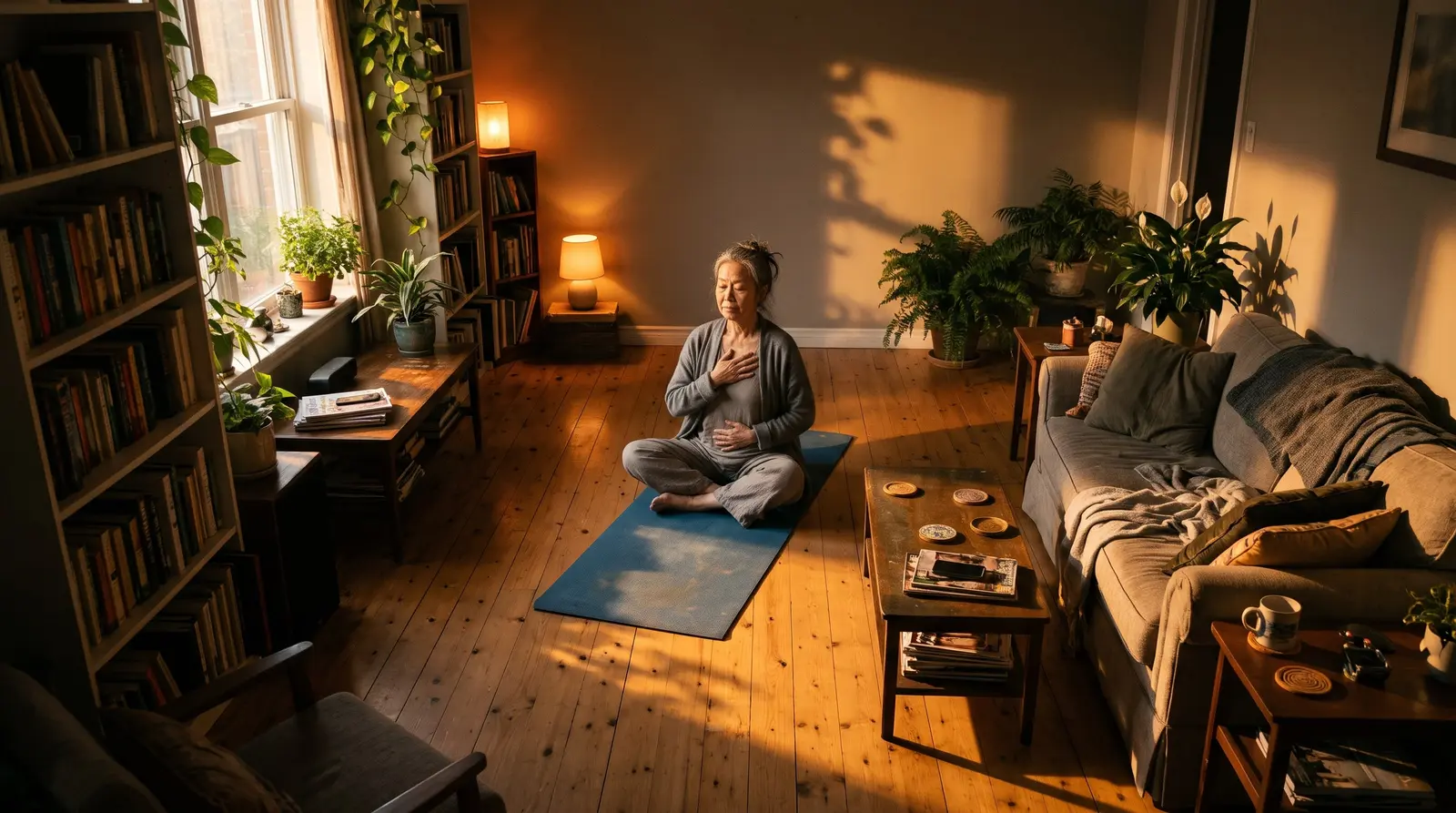
Slow your breath
Breathe in through your nose for a count of four, then out for a count of six. About ten rounds is plenty.
- 10 minutes before bed
Lights out, clock away
Turn the clock so you can't see it. If a worry pops up, picture setting it on tomorrow's list.
Want more ideas? Our guide to a relaxing bedtime routine has plenty.
Keep daytime stress from following you to bed
Your evenings go easier when your day had a few release valves. These are simple ways to manage stress as it happens:
Move in daylight. A short walk outside gives your body a break from sitting and your eyes a break from screens.
Take small pauses. A few slow breaths between tasks can keep stress from stacking up until night.
Talk it out. Saying a worry out loud to someone you trust can shrink it.
Keep coffee early if you notice it lingers into your evening.
Set a finish line. Choose a time when work is done for the day, and keep to it.

For more ways to settle a busy head, see how to calm a racing mind, day and night.
Why you wake at 3 a.m. when you're stressed, and what to try
If your body stays on alert through the evening, it can stay there into the night too. So when you surface from sleep, your mind may jump straight to whatever is bothering you.
Here's what to try when it happens:
Leave the clock alone. Counting how much sleep is left tends to wake you up more.
Keep the lights low and your phone away.
Breathe slowly, using the same four-in, six-out count from your evening.
Jot the worry down if it keeps looping, then let it wait for morning.
Get up if you're wide awake. Sit somewhere dim with something quiet, and go back to bed when you feel sleepy.

If your thoughts just won't quiet down, our piece on why you can't turn off your mind at night has more.
Ingredients research looks at for stress and sleep
Some plants and nutrients have long been used to support calm and rest. Here's what four of them are, why they're used and where the research stands.
Four ingredients used for calm and rest


Ashwagandha
A plant root. NCCIH says some ashwagandha preparations may help with sleep and stress.
L-theanine
An amino acid found in tea leaves. Small trials suggest it supports stress and sleep quality, and larger studies are still needed.
Lemon balm
A lemon-scented member of the mint family, traditionally used to calm nerves. It appears in research reviews of herbs that act on GABA, your brain's main slow-down messenger, and the human trials so far are small.
Reishi
A mushroom that research is looking at for calm and rest. The research so far is mostly in animals and small human studies, so the picture in people is still taking shape.
Ashwagandha has been in use as a medicinal plant for thousands of years, especially in traditional Ayurvedic medicine.
NCCIH notes that many ashwagandha studies were small and used different preparations [1], so results from one study can't always be compared with another.
For a wider look, see our ingredient-by-ingredient guide to natural sleep aids.
Frequently asked questions
Is sleep good for stress and anxiety?
Yes. So protecting your sleep is one of the kindest things you can do during a hard stretch.
How does lack of sleep affect mental health?
After short nights, you may notice a shorter fuse or a lower mood. If that sticks around for weeks, the safety notes at the end cover when to check in.
Why is it so hard to wake up in the morning when I'm stressed?
When stress keeps you up late or wakes you in the night, your alarm can catch you before you've had enough sleep. A steady wake time, even on weekends, and some morning daylight can help your body find its rhythm. If you sleep a full night and still wake exhausted, see the safety notes at the end.
Is it normal to sleep badly before a big day?
Yes. You might sleep badly before an interview, a trip or a hard talk, and your sleep usually settles once the day has passed. If it keeps happening week after week, see the safety notes at the end.
Why does my worry feel bigger at night?
At night there's less to distract you, so thoughts you pushed aside all day finally get the floor.
Safety notes and when to see a doctor
Even plant-based supplements can cause side effects or interact with medicines. Dietary supplements are not approved by the FDA before they're sold, so tell your healthcare providers about any you use [1].
References
These statements have not been evaluated by the Food and Drug Administration. This product is not intended to diagnose, treat, cure, or prevent any disease.


Comments
Sign in to join the conversation.
No comments yet. Be the first.