


Sleep anxiety, in plain words
Sleep anxiety is fear or worry about going to sleep [2]. You might feel fine all day, then tense up as bedtime gets close.
Maybe you dread the quiet, or the hours of lying there. Or maybe the fear is about sleep itself: what if tonight goes badly again?
If that sounds like your evenings, you haven't done anything wrong. Your body is reacting to stress, and there's a lot you can do to help it settle.

How sleep anxiety shows up in your body and mind
Sleep anxiety symptoms show up in your body and in your mind. Cleveland Clinic lists signs like these [2]:
A fast heart rate, even while you lie still
Sweating or feeling suddenly warm
Tense muscles you can't seem to let go of
Trembling or a shaky feeling
Restlessness, like you can't get comfortable
A sense of danger or doom, even when nothing is wrong
What a sleep anxiety attack can feel like
Sometimes worry builds into a sleep anxiety attack: a rush of panic as you try to settle. Some panic waves even arrive mid-sleep, which we compare just below.
Either way, your heart may pound and your thoughts may race to the worst case. It's frightening, and it does pass. The step-by-step plan further down walks you through those minutes.

Sleep anxiety vs insomnia: how to tell them apart
These often show up together, which is why they're easy to mix up. Here's the core difference, plus where night panic fits in.


Sleep anxiety, insomnia or night panic?
Three things that can overlap, each with its own feel.
Fear about bedtime or sleep
The dread starts before you lie down. It centers on sleep itself, or on the dark, quiet hours ahead.
- When it shows up
- Evening and bedtime
- Main feeling
- Dread or worry
Trouble falling or staying asleep
Insomnia is the sleep problem itself: lying awake, waking in the night or waking too early. Worry can be part of it, but it doesn't have to be.
- When it shows up
- Any part of the night
- Main focus
- Getting and staying asleep
A wave of panic during sleep
Nocturnal (nighttime) panic attacks happen only at night and often wake you from sleep. They bring strong body signs, like a racing heart or sweating.
- When it shows up
- During sleep
- Main feeling
- Sudden fear
Can sleep anxiety cause insomnia? It can. The loop below shows how one feeds the other.
What can set off your sleep anxiety
There's rarely one single cause. But a few triggers come up again and again, and knowing yours is the first step to easing it.
Common sleep anxiety triggers

Stress hormones that stay high
Stress raises cortisol and adrenaline, which hold your body on alert. When they stay high into the evening, relaxing before sleep gets hard.
A day with no pauses
When your day runs nonstop, the thinking you never had time for tends to wait for the quiet of bedtime.
Your own triggers may look different. The journal later in this article helps you find them.

How worry and poor sleep keep each other going
Anxiety and poor sleep feed each other. One usually makes the other worse, so it can feel like a never-ending cycle [2]. It's also part of why anxiety can feel worse at night.
Here's the hopeful part: a loop can break at any link. Each habit below loosens one of them.
How to overcome sleep anxiety: habits to start tonight
Many of these habits come from CBT-I, short for cognitive behavioral therapy for insomnia. It's a short talk therapy that teaches new sleep skills, and you'd usually finish it within four to eight sessions [3].
That's good news for you: these are skills you can learn. Start with the ones that feel easiest.
Wake up at the same time every day. A steady wake-up time is a core CBT-I habit [3]. Keep it on weekends and after rough nights too.
Plan a wind-down time, not just a bedtime. You can't make sleep show up on cue. You can choose when to start slowing down.
Build a buffer zone. Put screens away at least 30 minutes before bed [2], and fill that gap with something quiet.
Leave the clock alone. Turn it to face the wall. Checking the time starts the math (if you fall asleep now, you'll get five hours), and that math feeds worry.
Don't force it. Trying harder to sleep can backfire [3]. Make rest the goal, and let sleep arrive when it's ready.
Save your bed for sleep. Do your planning, scrolling and worrying somewhere else, so bed stays linked with rest.
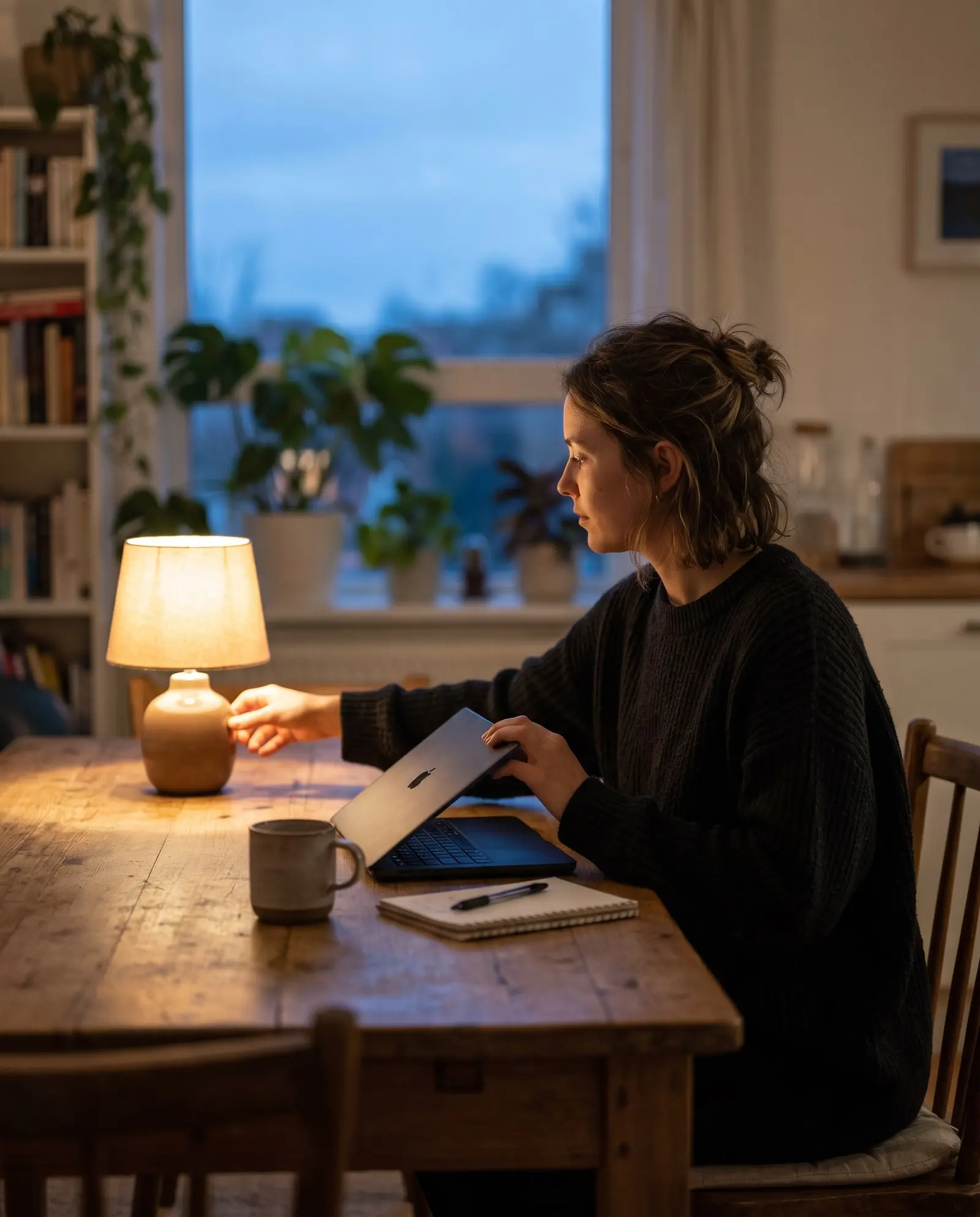
Stay in bed or get up when you can't sleep?
If you've been awake a while, lying there trying can make the worry louder. CBT-I suggests getting out of bed if you can't fall asleep within 15 to 20 minutes [3].
This is called stimulus control. The aim is for your bed to feel like a place for sleep, not a place for struggle.
Go to another room and keep the lights low. [3]
Read a paper book, fold laundry or listen to quiet music until you feel sleepy.
Return when your eyelids feel heavy. Repeat as often as you need.
No need to time it exactly. Go by how you feel, and a rough guess is enough.
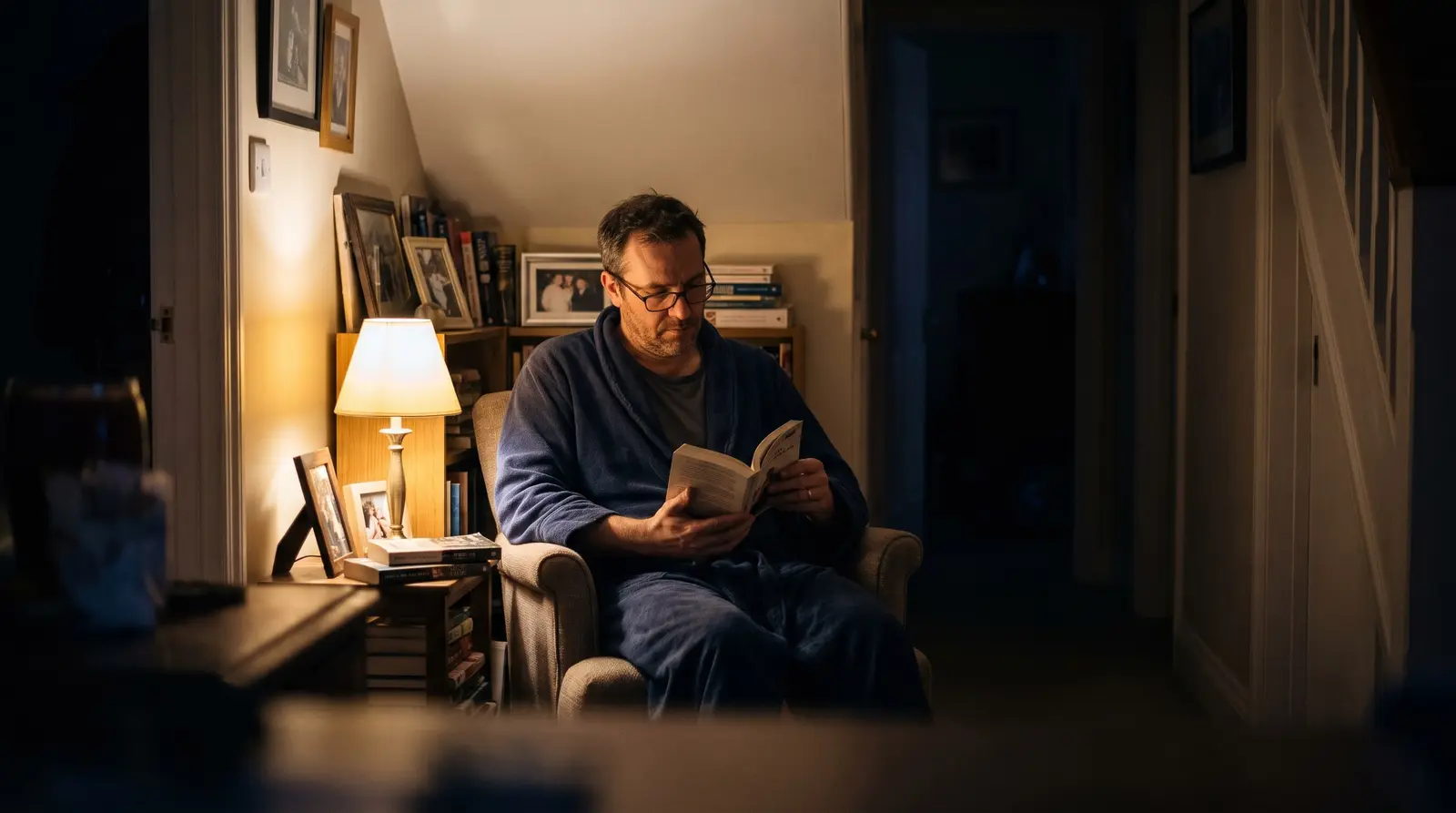
Give your worries an earlier time slot
Worries that crowd in at night often feel smaller in daylight. So give them their own time slot, well before bed.

Three ways to park a worry
Pick the one that fits how your mind works, or mix them.
Worry on purpose, earlier
Set aside about 15 minutes in the late afternoon. Write down what's bothering you and think it through. When a worry shows up at bedtime, remind yourself it has a slot tomorrow.
- When
- Late afternoon
- How long
- About 15 minutes
- Best for
- Worries that repeat
Write a mental dump list
Early in your wind-down, write everything on your mind, big or small. Once it's on paper, you don't have to hold it in your head.
- When
- Start of your wind-down
- How long
- 5 to 10 minutes
- Best for
- A cluttered mind
Give each worry one next step
For a worry you can act on, write one small next step and when you'll do it. Then close the notebook for the night.
- How long
- A few minutes
- Best for
- To-dos and problems
When thoughts keep spinning anyway, our piece on why your mind won't switch off at night goes deeper.

What to do during a sleep anxiety attack at night
When panic rises in the dark, a simple plan gives your mind something steady to hold. Try these steps in order.
Name it. Tell yourself: this is anxiety. It's uncomfortable, and it will pass.
Slow your breath. Use the longer-out-than-in breathing shown in the next section.
Ground yourself with 3-3-3. The box below shows how.
Turn on a soft light. A dim lamp can make the room feel less closed in.
Skip the phone and the clock. Both give your mind more to chew on.
Change rooms if it lingers. Use the get-up steps above, then return when you feel drowsy.
Relaxation and mindfulness to practice
Practice these on calm evenings first. That way, they already feel familiar when worry shows up.

Pick a way to relax
Each takes only a few minutes, in bed or in a chair.
Longer out than in
Breathe in for four counts and out for six. Keep it gentle, and let your belly rise instead of your shoulders.
- Time
- 3 to 5 minutes
- Good for
- A pounding heart
Tense, then let go
Starting at your feet, tense one muscle group for a few seconds, then let it go. Notice the difference, then work your way up to your face.
- Time
- About 10 minutes
- Good for
- Tight shoulders and jaw
Notice, then come back
Rest your attention on your breath or the feel of the bed. When a thought pulls you away, notice it and gently come back, with no judging.
- Time
- 5 to 10 minutes
- Good for
- Looping thoughts
Curious how your body shifts gears at night? See the science of winding down.
Caffeine, alcohol and late meals
Your evening plate and glass are worth a look too. Cleveland Clinic's sleep tips cover both caffeine and alcohol [2].
Evening choices to notice

Move your last cup earlier
Coffee, many teas, cola and energy drinks all count. Try having your last one before the late afternoon.
Swap the nightcap
A drink can seem to take the edge off, but it's best kept away from bedtime. A warm, caffeine-free drink is a gentler swap.
Notice what late eating does
There's no single rule here. If a big or late dinner leaves you wired or uncomfortable, note it in your journal and try a lighter evening.
If sweets are part of your evening, we look at whether sugar keeps you up.
A sample 60-minute wind-down routine
A routine gives worry less room, because your evening already has a shape. Shift the times to match your own bedtime.
Your 60-minute wind-down
- 60 min before
Dim the lights
Switch to lamps and lower overhead lights so your home starts to feel like evening.
- 50 min before
Brain dump
Write what's on your mind and one next step for anything you can act on. Then close the notebook.
- 40 min before
Wash up
Take a warm shower, brush your teeth and change into something soft.
- 30 min before
Screens away
Charge your phone outside the bedroom, or at least out of reach.
- 20 min before
Something quiet
Read a paper book, stretch gently or listen to calm music.
- 10 min before
Slow breathing
A few minutes of in-for-four, out-for-six breathing, sitting or lying down.
- Bedtime
Lights out
Turn off the lamp, settle into your pillow and let the day go.
Want more ideas to build on? Our bedtime routine guide for adults has plenty.
How daytime stress carries into bedtime
Calmer nights often start in the afternoon. A few small changes can help your day wind down before you do.
Take short pauses. A few slow breaths between tasks gives your body a chance to come down a notch.
Step outside at midday. A short walk in daylight breaks up a long stretch of sitting and thinking.
Close out your workday. Write tomorrow's top three tasks, then shut the laptop. It marks a clear end.
Move hard talks earlier. Tough conversations and big decisions can sit easier before dinner than at 10 p.m.
We cover this from both sides in how to calm a racing mind, day and night. And if stress leaves you drained, see why you may feel tired all day.
A simple sleep and worry journal
A sleep diary can help you spot what makes it harder to fall asleep or stay asleep [2]. Add a line for worry, and it becomes a map of your own triggers.

| What to write | Example |
|---|---|
| Time in bed and wake-up time | 11:00 p.m. to 6:45 a.m. |
| Last caffeine and any alcohol | Coffee at 2 p.m., no alcohol |
| Screens off at | 10:20 p.m. |
| Worry level at bedtime (0 to 10) | 6 |
| Main worry | Work deadline on Friday |
| Rough time to fall asleep | About 40 minutes |
| Times you woke up | Once, around 3 a.m. |
| How you feel in the morning (0 to 10) | 4 |
After two weeks, look for patterns. Do your hardest nights follow late coffee, a packed day or one worry that keeps coming back?
What's in common sleep and calm supplements
Curious about supplements? Here's what research says about a few calming ingredients. Think of them as one piece of your evening, next to the habits above.

| Ingredient | Traditional or common use | Research so far |
|---|---|---|
| Ashwagandha root | An Ayurvedic herb used to support a healthy response to stress | Some preparations may help sleep and stress; many studies are small |
| L-theanine | An amino acid found in tea leaves | Small trials suggest benefits for stress and sleep quality; larger studies are needed |
| Lemon balm | A mint-family herb traditionally used to calm nerves | Small human trials so far |
| Reishi mushroom | A mushroom long used in traditional East Asian medicine | Mostly animal research, plus small human studies |
Why ashwagandha has a sleepy name
Ashwagandha has been used as a medicinal plant for thousands of years, especially in Ayurvedic medicine [1]. Its Latin name is Withania somnifera, and somnifera means sleep-inducing.
NCCIH, part of the National Institutes of Health, notes that the research on anxiety itself is still unclear. Studies so far have also used many different preparations, which makes them hard to compare [1].
Lemon balm and your slow-down messenger
Lemon balm is one of the herbs researchers have reviewed for how they act on GABA, your brain's main slow-down messenger.
For a fuller tour, our ingredient-by-ingredient guide to natural sleep aids covers more options.
Reading a supplement label with care
The FDA doesn't approve dietary supplements before they're sold [1]. So a careful read of the label is up to you.
Read the full ingredient list. Blends can hold many herbs, and each one has its own cautions.
Change one thing at a time. If you start a supplement and a new routine the same week, you won't know which one helped.
Track it in your journal. Note when you took it and how your night and morning felt.
Read the safety notes at the end first. They list the cautions for each ingredient here.
Frequently asked questions
Does melatonin help with anxiety?
Melatonin is a hormone that encourages your natural sleep cycle. Its best evidence is for sleep timing, like jet lag and a delayed sleep schedule, rather than for worry itself. The safety notes at the end cover cautions.
Does magnesium help you sleep when you're anxious?
Magnesium is a mineral that supports normal muscle and nervous-system function. Research on magnesium for sleep is limited and mixed, and most studies so far are small.
Should I track my sleep if I have sleep anxiety?
A tracker can be useful, but if checking your score makes you tense, it's feeding the loop. Try hiding the score for a week and using a simple paper journal instead. Notice how you feel during the day, not just a number.
How long does it take to get past sleep anxiety?
It varies, and steady habits matter more than speed. With CBT-I, your sleep often improves within six to eight weeks of starting.
What if anxiety wakes me up in the middle of the night?
The night plan above works at 3 a.m. just as it does at bedtime. If night panic wakes you often, the safety notes at the end cover next steps.
Safety notes and when to see a doctor
Please read these notes before you try any supplement. They also cover when sleep anxiety deserves a doctor's help.
Ingredient and supplement cautions
Ashwagandha: It may be safe short term, up to 3 months [1]. Avoid it if you're pregnant or breastfeeding, about to have surgery, or have a thyroid or autoimmune condition [1].
More on ashwagandha: It may interact with medicines for diabetes, blood pressure and thyroid, and with sedatives or immune-suppressing drugs. It can cause drowsiness or an upset stomach, and rare cases of liver injury have been reported [1].
L-theanine: It may lower blood pressure slightly. Check with your doctor if you take blood-pressure medicine.
Lemon balm: It can add to drowsiness, so don't combine it with alcohol, sedatives or sleep medicines. It may also interact with thyroid medication.
Reishi: It may interact with blood thinners and blood-pressure or diabetes medicines.
Valerian and other sedating herbs: Don't combine them with alcohol or sedatives.
Melatonin: Keep to the label's directions. It can cause next-day grogginess.
5-HTP, a building block your body turns into serotonin: don't take it with SSRIs, MAOIs or other serotonergic drugs without your doctor.
St. John's Wort: It interacts with many medications, so check before combining it with anything you take.
When to see a doctor
Sleep anxiety can have a medical side. Getting help is a practical step, not a last resort.
Your doctor will likely do a physical exam, review your medical history and ask about your bedtime habits [2]. They may suggest an overnight sleep study to check for a sleep disorder [2].
Ask about CBT-I too, since it's considered the first-line treatment for insomnia, meaning the first one doctors usually suggest [2]. And don't start any medicine for anxiety or sleep without your doctor's guidance, because some over-the-counter sleep aids can be habit-forming [2].
References
These statements have not been evaluated by the Food and Drug Administration. This product is not intended to diagnose, treat, cure, or prevent any disease.


Comments
Sign in to join the conversation.
No comments yet. Be the first.