


Why does my anxiety get worse at night?
If your mind gets louder the moment the lights go off, you're not imagining it. A few things shift in your body and your evening at the same time.
Fewer distractions, louder thoughts
All day, work, talk and noise keep your attention busy. At night those fade, so worries and racing thoughts get the whole stage, right when you want to fall asleep [1].
Your cortisol rhythm dips
Cortisol is a hormone that helps keep you alert by day. Its levels fall in the evening, and as they drop, you may feel less able to manage anxious thoughts [1].
Stillness turns up body signals
When you lie still, you notice a racing heart or tense muscles more easily [1]. Your brain can read those signals as a warning, which makes the worry feel bigger.
Anxious at night for no reason?

That's why you can get anxious at night for no reason you can name. Nothing new has to go wrong: the quiet, the cortisol dip and the stillness simply line up at once.
Feeling scared at night for no reason works the same way. A dark, quiet room gives your mind less to anchor to, so a creak in the hallway can feel bigger than it is.
The loop between anxiety and sleep
Anxiety can switch on your body's stress response, a chain of effects that keeps your body on alert. That can leave you too wound up to drift off [1].
How anxiety and short sleep keep each other going
Your body stays on alert, so winding down is hard. [1]
Less deep sleep and less REM, the dreaming stage, leave you less rested. [1]
Fearing another bad night makes falling asleep even harder. [1]
Less sleep than usual is linked to more anxiety the next day. [1]
Over time, poor sleep can make anxiety worse, so the two keep each other going [1]. That's what's happening when your anxiety keeps you awake.
The upside: a loop has more than one place to step in. A calmer day, a steady wind-down and the right help when you need it all count.
Evening anxiety symptoms and waking up anxious
Evening anxiety can show up as a racing mind, muscle tension, a fast heartbeat, sweating, and trouble falling or staying asleep [1]. You may notice one of these, or several at once.
Why you might wake up with anxiety in the middle of the night
Sometimes anxiety doesn't wait for bedtime. A nocturnal panic attack is a sudden wave of fear that wakes you up, often with a sense that something bad is about to happen [1].
It feels scary, but your breath is a tool you can reach for right then. One pattern the Sleep Foundation shares is 4-7-8 breathing [1].
Your out-breath is twice as long as your in-breath, so your whole rhythm slows down. Repeat a few rounds, then let your breathing settle on its own.
Anxious in the afternoon, or only during the day?
Your anxiety may keep its own schedule. Noticing when it shows up can help you choose where to start.


When does your anxiety show up?
Find the pattern that sounds most like you.
Anxiety only at night
If your days feel fine but evenings get loud, your evening itself is the place to start. A wind-down that gives your mind something calm to hold onto is your best starting point.
- Often feels like
- A racing mind as soon as you lie down
- Start with
- The evening plan below
Anxiety that builds in the afternoon
If last night was short, think back to the loop above: a short night can carry into today. The coffee you reach for to push through may add to it, more on that below.
- Look at
- Last night's sleep and your afternoon cup
Anxious by day, calm at night
If you feel calmer once the day's demands stop, your workday is a good place to start.
- Look at
- Your workload, your breaks and your to-do list
Stress and big life changes
Pressure at work, money worries and big changes like a move or a new job tend to surface when you finally stop. Trauma and genetics can play a part too [1].
Good days help good nights. A few slow breaths between tasks, a real lunch break or a short walk outside lowers what you carry into the evening. Our guide to calming a racing mind, day and night has more ideas.

An evening plan for when anxiety creeps in
You can't flip a switch on anxiety, but you can give your evening a shape that makes calm easier to find. Everything here is free.

Three free ways to settle an anxious evening
Each works in its own way, so start with the one that fits you.
A detailed to-do list
Writing a detailed list of tomorrow's tasks before bed has been linked to falling asleep faster. Once the tasks are on paper, your mind doesn't have to hold them all night.
- When
- As you start winding down
Progressive muscle relaxation
You tense one muscle group for a few seconds, then let it go, working from your feet up to your face. It's one of the techniques that can help with nighttime anxiety.
- When
- Just before sleep
Regular exercise
Exercise is another habit that can help with nighttime anxiety. A walk, a ride or a class earlier in the day gives your body a different way to spend its stress.
- When
- Earlier in the day
Your calm last two hours
- 2 hours before
Close the day
Wrap up work and email, then write tomorrow's to-do list.
- 90 minutes before
Lower the lights
Switch to lamps so your evening looks and feels different from your day.
- 1 hour before
Something warm and slow
A warm shower or bath, a caffeine-free tea, or a few pages of a paper book.
- 30 minutes before
Park your phone
Charge it outside your bedroom so late scrolling isn't an option.
- 15 minutes before
Unwind your body
A round of muscle relaxation or 4-7-8 breathing.
- Bedtime
Lights out, same time
A steady bedtime, night after night, gives your body a rhythm to settle into.
Watch what's in your cup
Caffeine and nicotine can both trigger anxiety [1]. If your evenings feel jittery, move your last coffee earlier and notice how your nights change.

Make your bedroom a calmer place
A cool, dark, quiet room gives your body fewer things to react to: thicker curtains, a fan for steady sound, a clock turned away so you can't watch the minutes.
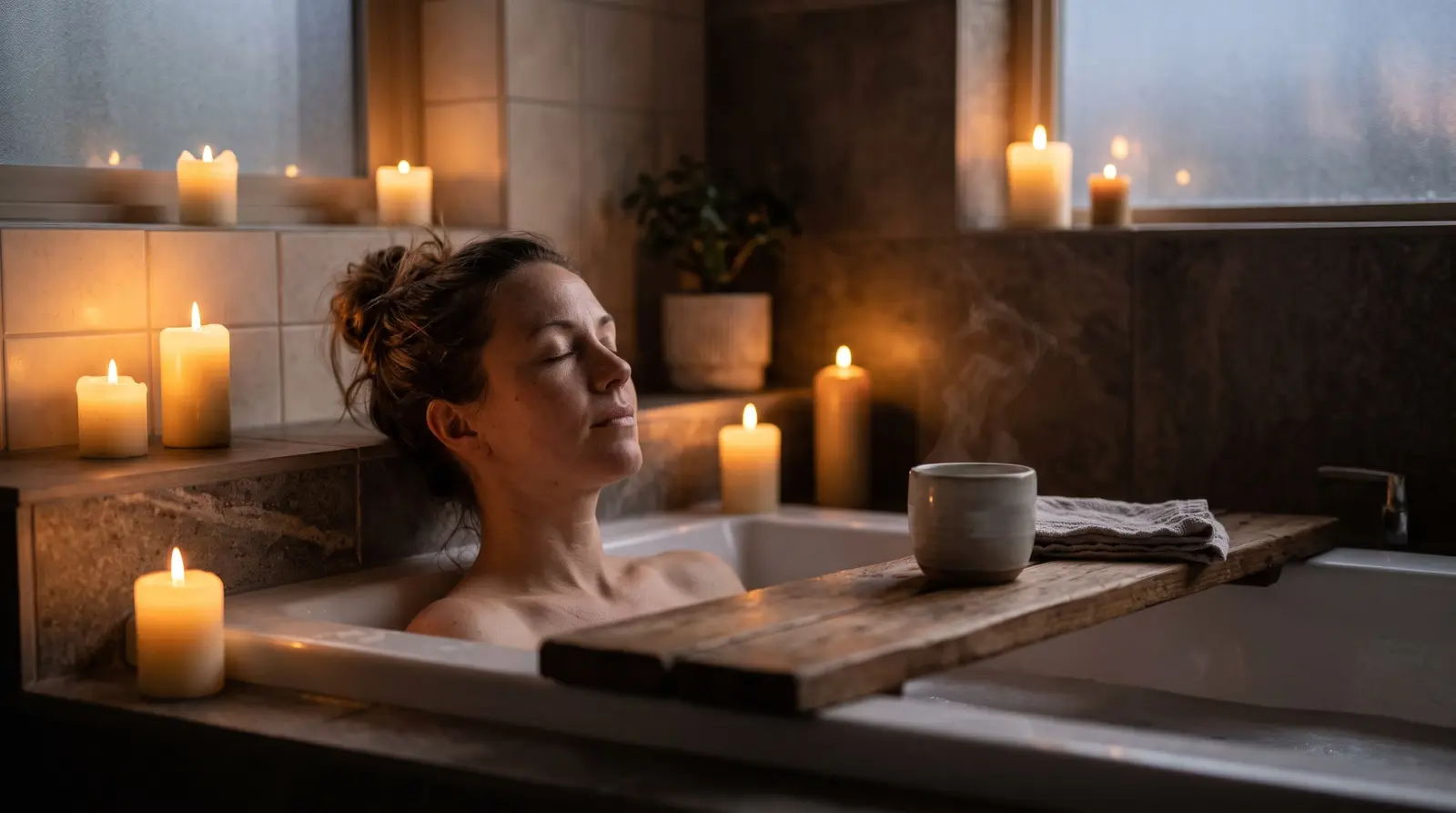
For a fuller plan, our bedtime routine guide builds out each step. If racing thoughts are the loudest part, here's why you can't turn off your mind at night.
Should you take something? What research says about calming ingredients
If you're wondering whether to take something for anxious nights, it's a fair question. These four ingredients come up often for calm, and here's where the research stands.
Four calming ingredients, in brief

Ashwagandha
Used for thousands of years in Ayurvedic medicine. Some preparations may help with stress and sleep, though the studies are small and use different forms.
L-theanine
An amino acid found in tea leaves. In healthy volunteers under stress, it eased felt and physical signs of stress, and trials suggest it supports sleep quality.
Lemon balm
A lemon-scented herb used for generations to calm nerves. Europe's medicines agency recognizes it, based on traditional use, for mild stress and to aid sleep.
Reishi
A mushroom traditionally used for restless sleep. Human research on calm and sleep is still limited, so its story today is mostly one of tradition.
L-theanine seems to support sleep by easing a busy mind, not by making you drowsy [5]. Its relaxing effect showed up mostly in volunteers who started out a little more anxious or were under stress [5].
In a trial of 71 volunteers, 14 days of lemon balm extract helped with heart palpitations and anxious feelings, though the studies so far are small [3].

How might lemon balm support calm? Early lab work points to GABA, your brain's main slow-down messenger.
How lemon balm may support calm
In rat brain tissue, it blocked GABA transaminase, the enzyme that breaks GABA down. [3]
With less breakdown, GABA levels rose in the lab. [3]
GABA helps quiet brain activity. This path is a lab finding, not yet shown in humans.
Frequently asked questions
How do I calm my mind for sleep when worries keep coming back?
Try giving each worry a time slot. When one shows up in bed, tell yourself you'll deal with it tomorrow at a set hour, then bring your attention back to your breath.
Should I stay in bed if anxiety keeps me awake?
If you've been lying awake and wound up for a while, it's often better to get up. Sit somewhere dim and do something calm, like reading a paper book, then go back to bed when you feel sleepy. That way your bed stays tied to rest, not worry.
Safety notes and when to see a doctor
The FDA doesn't approve supplements before they're sold [2]. So it helps to know each ingredient's cautions before you start.
References
- Anxiety at Night: Causes and Tips for Relief. Sleep Foundation.↩
- Ashwagandha. NCCIH, National Institutes of Health.↩
- Medicinal Plants Used for Anxiety, Depression, or Stress Treatment: An Update (Molecules, 2022). PMC / National Library of Medicine.↩
- Effects of L-theanine on cognition, mood and sleep: evidence from human trials. PubMed / National Library of Medicine.↩
- l-theanine: From tea leaf to trending supplement – does the science match the hype for brain health and relaxation? PMC / National Library of Medicine.↩
- Pharmacological Activities and Safety of Ganoderma lucidum Spores: A Systematic Review. PMC / National Library of Medicine.↩
These statements have not been evaluated by the Food and Drug Administration. This product is not intended to diagnose, treat, cure, or prevent any disease.


Comments
Sign in to join the conversation.
No comments yet. Be the first.