


Why you wake up to pee at night
If you keep padding to the bathroom in the dark, you're not doing anything wrong. Your body is sending you a signal, and you can learn to read it.

Doctors call it nocturia: regularly waking up more than once in the night because you have to pee [2]. It's very common, especially from your 50s on [2].
At night, your body normally makes less urine than it does by day. [1]
Vasopressin, also called antidiuretic hormone, helps control how much water your body keeps. [2]
Big evening drinks, caffeine or alcohol after dinner, some medicines and sleep problems can push more urine into your night. [1]
So when you wake to pee, something has tipped that balance. Each trip also pulls you up out of sleep, which can leave you tired the next day.
Is getting up to pee once or twice normal?
Getting up once or twice to pee can be normal [2].
The count matters less than how it feels to you.
What's the main cause of waking up to pee?
There's rarely one single cause. It helps to sort the reasons into three groups: what you drink, how much urine your body makes at night, and how deeply you sleep.
What you drink, and when
The simplest reason is a lot of fluid in the evening, especially caffeine or alcohol with or after dinner [1]. Fizzy drinks can add to it too [2].
When your body makes more urine at night
Some nights your body simply makes too much urine after dark.
One reason can be that your body makes less vasopressin, the hormone that helps you hold on to water [2]. Swollen legs are on the list of causes too [1].
Your sleep itself
Sleep disorders are linked to night trips too. Obstructive sleep apnea, where your breathing keeps pausing in your sleep, is one, and restless legs syndrome is another [1][2].
If your night trips come with tiredness that lasts all day, our guide on why you feel tired all day is a good next read.
Nocturia may go away when the sleeping problem is under control.
Why do I pee every 2 hours at night?
If you're up every 2 hours, even on nights you barely drink, look past the water glass. The causes above can play a part, and so can an overactive bladder, one that signals 'go' before it's full [2].
Habit matters too. Cleveland Clinic lists a habit of waking up to pee even when you don't need to as a common cause [2], so it's a pattern worth noticing.
Wake-then-pee or pee-then-wake? How to tell
Here's a simple self-check. Did you wake because you had to pee, or did something else wake you, and then you noticed your bladder?


Which one sounds like your night?
Two patterns that feel the same at 3 a.m. but point in different directions.
Your bladder is the alarm
You surface with a strong, clear urge. This can point toward fluid or your bladder: evening drinks, your body making more urine at night, or a bladder or prostate change.
- Clue
- Strong urge, full bladder
- Look at first
- Evening drinks, medicines, a bladder diary
Something else woke you
You're awake first, maybe from noise, heat or worry, and then you figure you might as well go. This can point toward your sleep: light sleep, stress or restlessness.
- Clue
- Awake first, mild urge
- Look at first
- Your sleep space, stress, how rested you feel by day
So can poor sleep make you notice the urge more often? It can. Stress and restlessness can wake you [1], and once you're up, even a half-full bladder is easy to notice.
That's why better sleep can mean fewer trips, even when nothing about your bladder changes.
A 3-day bladder and sleep diary to bring to your doctor
MedlinePlus and Cleveland Clinic both suggest a diary of how much you drink, how often you pee and how much [1][2]. Ours adds your sleep, so you can see which comes first.
| Time | What you drank | Peed? How much | What woke you | Back to sleep in |
|---|---|---|---|---|
| 6:30 pm | Dinner, 1 glass of water | No | ||
| 9:45 pm | Herbal tea, small cup | Yes, medium | ||
| 10:30 pm | None | Yes, small | Bedtime | |
| 2:50 am | None | Yes, large | Strong urge | About 20 min |
| 5:40 am | None | Yes, small | Noise outside | Stayed awake |
Bring all three days with you. The pattern often tells your doctor more than any one night.
Woman peeing a lot at night? Hormones, age and your pelvic floor
If you're a woman and your night trips have crept up, you're not imagining it. Before age 50, nocturia is more common in women [2].
Childbirth, menopause and pelvic organ prolapse can all affect your bladder [2]. Prolapse means the organs in your pelvis have dropped lower because the tissue holding them up has weakened.

In general terms, your pelvic floor is a sling of muscles under your bladder that helps you hold urine.
There's real help here. Pelvic floor physical therapy is one of the steps Cleveland Clinic lists [2].
Why do I pee so much at night but not during the day? A note for men
If you're a man, your prostate is one place to look. The prostate is a small gland just below your bladder that wraps around the tube urine leaves through.
When it grows with age, it's called an enlarged prostate, or BPH, and it's one of the listed causes of night trips [1]. Overall, nocturia is more likely in men than in women [2].

That night-only pattern is a clue in itself. The 3-day diary above helps you and your doctor read it.
Why do I pee more at night as I get older?
Age plays a big part, because the causes can stack up: a prostate or pelvic floor change, a new medicine, lighter sleep.
Getting older doesn't mean you just have to live with it. The habits below help at any age.
How to finally stop waking up to pee at night: your evening plan
Your evening is where the free fixes live. Here's a simple plan you can shape around your own bedtime.
Your evening plan for fewer night trips
- Afternoon
Front-load your drinks
Get most of your fluids in earlier in the day, so you're not catching up at night.
- Dinner
Go easy on caffeine and alcohol
Skip caffeine and alcohol with or after dinner, and keep fizzy drinks to earlier in the day.
- After dinner
Sip, don't gulp
Drink less as bedtime gets closer. If you're thirsty, take small sips.
- Wind-down
Dim the lights
Lower the lights and set your phone aside.
- Last stop
Empty your bladder
Pee right before you get into bed, and switch on your low night-lights.
- Bedtime
Lights out
Settle in knowing any trip tonight can stay calm, dim and quick.
Give the plan a week or two. Your body may need time to settle into a new rhythm.
Does drinking water before bed make you wake up to pee?
It can. But don't go thirsty all day to make up for it: the goal is to move most of your water earlier, as in the plan above.

How long before bed should you stop drinking?
There's no one magic number for everyone. The steady advice is to drink less before bed [2], then use your diary to find the cutoff that works for your body.
If your mouth gets dry at night, keep a small glass for sips, not a big bottle.
Hidden evening diuretics: the sneaky drinks and treats
A diuretic is anything that makes your body pass more urine. A few of them hide in the cozy things you reach for after dinner. Black tea and green tea carry caffeine, just like coffee.
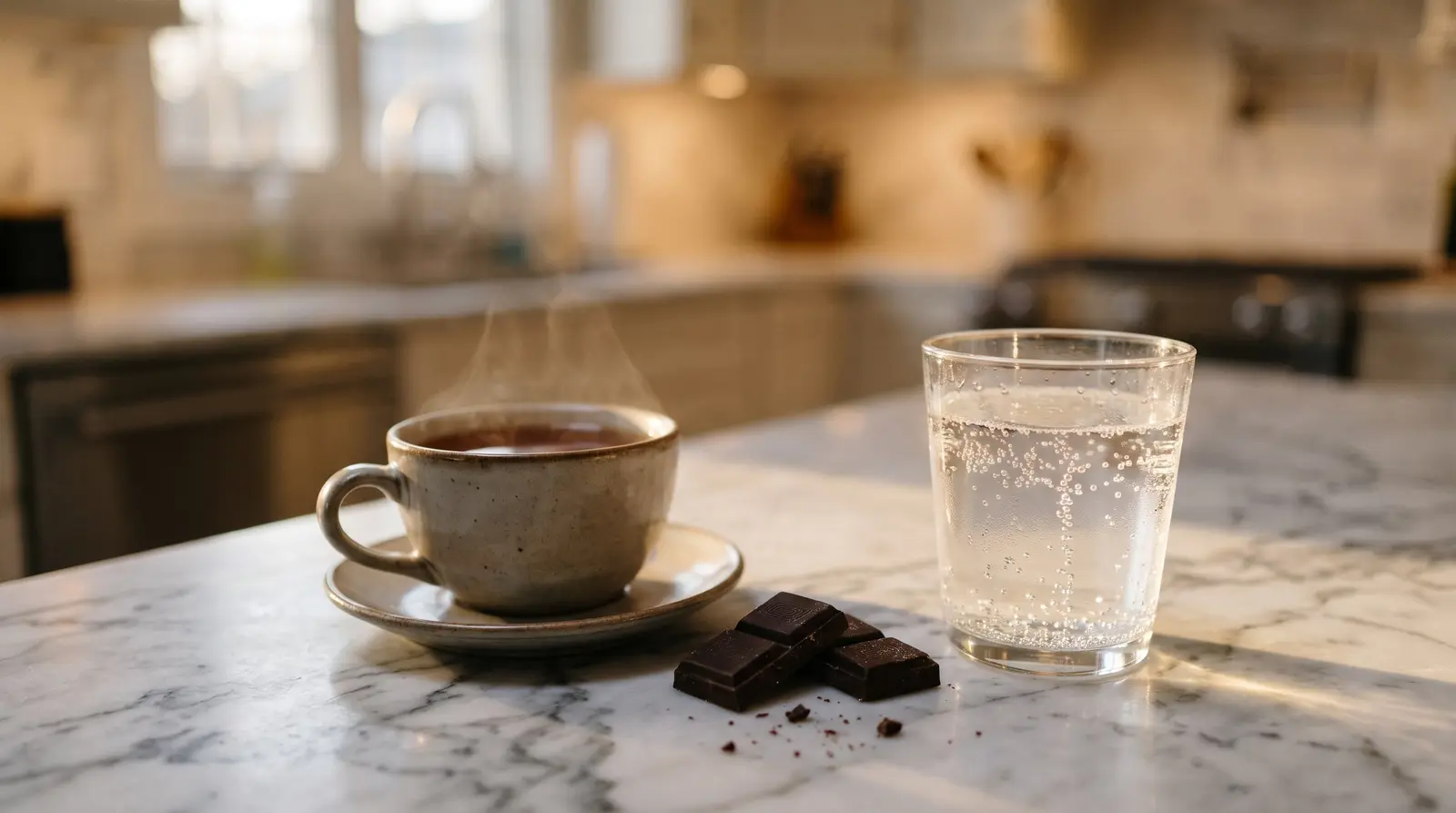
You don't have to give them up. Try moving them earlier in the day and see how your nights change.
Daytime habits that shift fluid to your night
What you do by day shapes your night. If your ankles feel puffy by evening, that fluid has to go somewhere.
Cleveland Clinic suggests raising your legs while you sit at home to help with how fluid is spread through your body [2]. Compression stockings are on its list too [2].

Sleep hygiene: why better sleep can mean fewer trips
Protecting your sleep is part of the plan, and these simple habits help.
Keep your room cool, dark and quiet.
Go to bed and get up at about the same time every day.
Keep your bed for sleep, so your brain links it with rest.
For a fuller wind-down, our guide to the science of winding down walks you through it step by step.
Is there a best sleeping position?
We didn't find one best sleeping position for night trips in the research. So sleep in whatever position lets you rest.
Getting back to sleep fast after a bathroom trip
The trip itself takes a minute or two. Getting back to sleep is where your night can slip away, so plan for it.
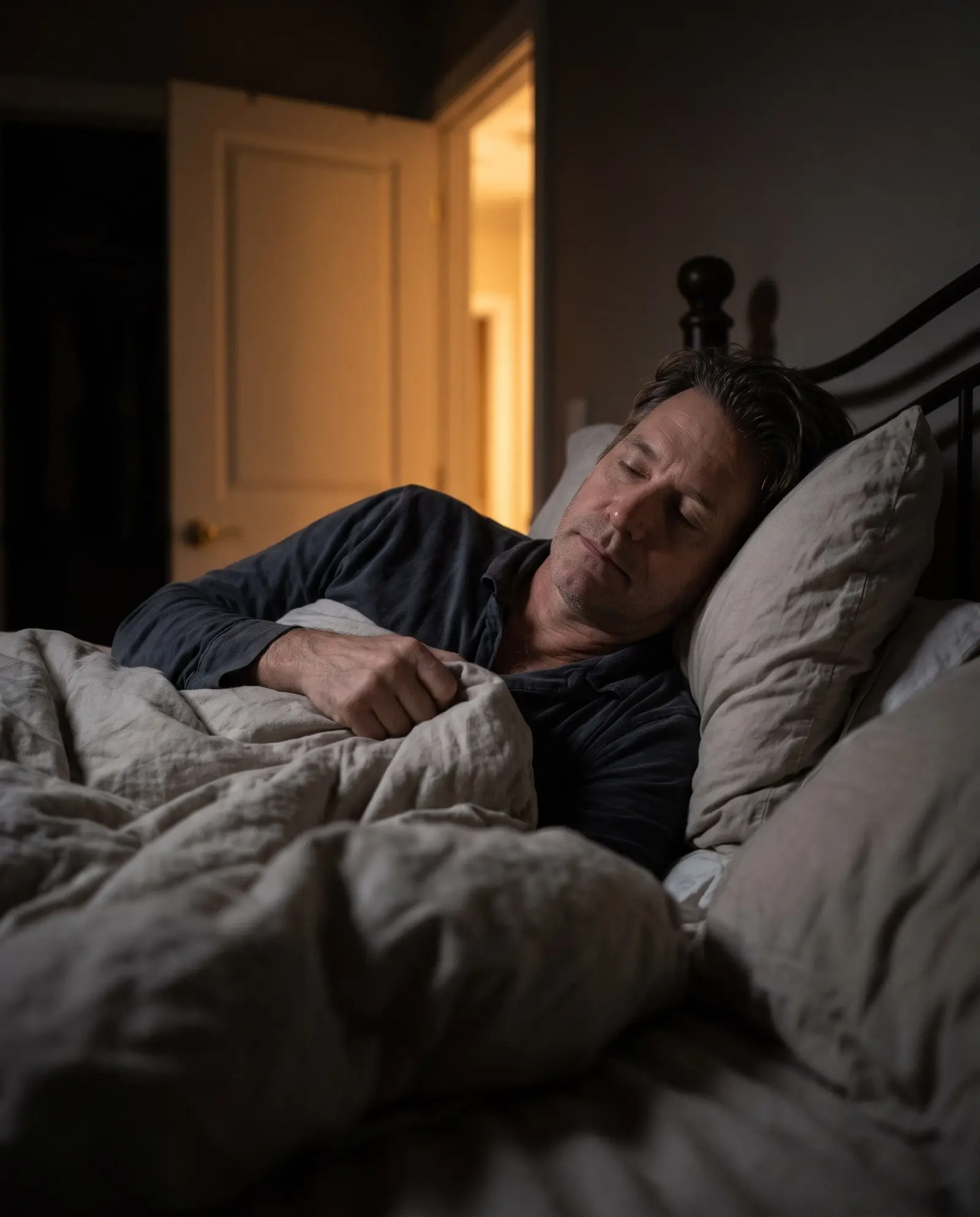
Keep the light low and warm. A dim night-light, warm or red-toned, shows the way without a full wake-up.
Leave your phone and the clock alone. Counting the hours left can rev up your mind.
Move slowly. No rushing and no straining.
Breathe out long. Back in bed, take a few slow breaths where your out-breath is longer than your in-breath.
Let it be. If you're still awake after a while, rest calmly instead of fighting it.
Make your nighttime bathroom path safe
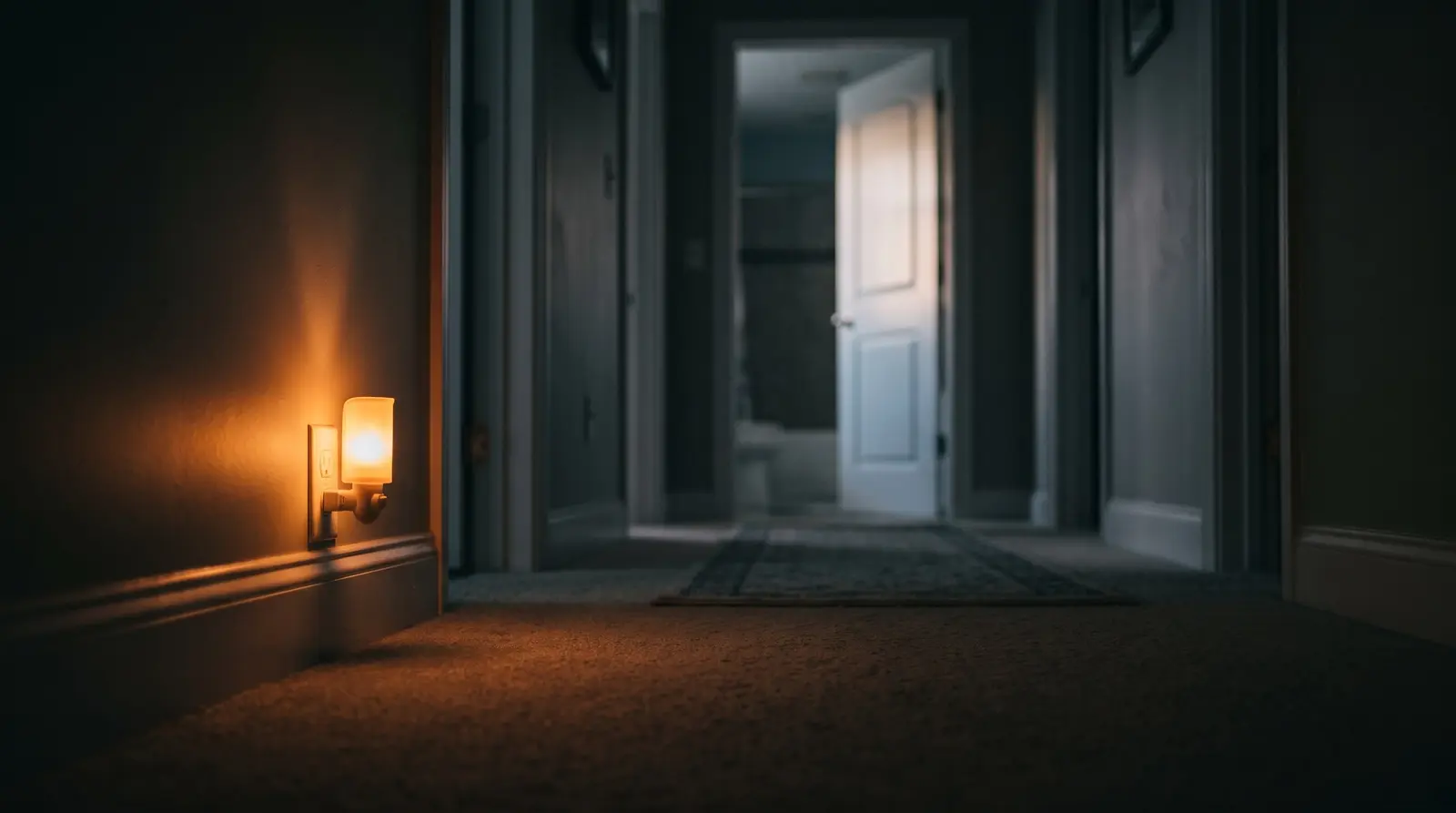
A sleepy walk in the dark is when slips happen. A safe path also keeps the trip short and calm, so you wake up less.
Clear the floor between your bed and the bathroom: shoes, cords and loose rugs.
Plug in low night-lights along the way.
Keep a lamp or switch you can reach from bed.
Sit on the edge of the bed for a few breaths before you stand.
Put a non-slip mat in the bathroom.
Where a sleep supplement fits into your nights
A sleep supplement's job is your sleep: winding down and settling in. How much urine your body makes is a job for the habits above and your doctor.
So start there. Then, if you'd like support for a calmer wind-down, here are a few ingredients used for sleep and what the research says.
Melatonin: your body's 'it's night' signal
Melatonin is a hormone your brain makes in response to darkness. It helps time your body's 24-hour clock and your sleep, and light at night can block it [3].
Research suggests melatonin supplements may help with jet lag and a sleep schedule that runs late [3].
Magnesium: ease for your muscles and nerves
Magnesium helps your nervous system and your muscles relax.
A 2021 review looked at 3 small studies in older adults who had trouble falling asleep. It suggests magnesium may help you fall asleep faster. But the reviewers said the studies were low quality, so the research is still early [4].
5-HTP and calming botanicals
5-HTP is a building block your body turns into serotonin. It supports normal serotonin levels, and serotonin is the precursor to melatonin.
Chamomile, lemon balm, passion flower and hops are calming botanicals traditionally used to help you unwind.
Frequently asked questions
Why do I wake at 3am to pee?
Whatever the hour, the question is the same: did the urge wake you, or did you wake first? The self-check and the 3-day diary above help you find your pattern.
How do I stop waking up to pee at night?
The evening plan and the sleep habits above are the best place to start.
Safety notes and when to see a doctor
Waking to pee can be your body's early signal that something else needs care. You don't have to wait until it's bad to ask about it.
Your doctor may check your blood sugar and kidney function and test your urine [1][2].
Treatment depends on the cause [1]. If a water pill is behind it, your doctor may have you take it earlier in the day, such as in the morning or at least six hours before bed [1][2].
References
These statements have not been evaluated by the Food and Drug Administration. This product is not intended to diagnose, treat, cure, or prevent any disease.



Comments
Sign in to join the conversation.
No comments yet. Be the first.